Understanding Projectile Motion : Derivations

Projectile Motion is one of the basic thing we encounter in our daily life. Studying it becomes important because the ‘understanding’ (not mugging up Formulae) which we take here comes handy while analyzing complex concepts and experiments 

“Formulae give you Marks but Derivations give you Understanding !

We already do have a video on our Channel about such a experiment on our channel where knowledge of Projectile is needed for the Analysis part :


Equation of Trajectory

We all have played ‘catch-catch’ and we know how the motion of a ball when thrown looks like. But how do you describe that curve mathematically. What’s the equation of that curve ?

Most Important Tip that fixes everything related to Projectile !

Divide this whole 2-D situation into separate 1-D problems (X and Y)

  • Note down all quantities in X separately. This will be your separate problem
  • Note down all quantities in Y separately. This will be your another separate problem
  • At last, combine them to get results for 2-D motion

Following the Tip :

Starting from origin (point where ball is throwed) till point P (x,y) :

The Projectile Trajectory is a Parabola !


Finding Range Expression

Range is basically the ‘horizontal’ distance which the ball covers (from origin to the point where it lands). It means that, we need to find R in the figure

  • This can be easily found since x = 0 and x = R are the two roots of the parabola.
  • To calculate the roots, simply put y = 0 in our Equation of Trajectory

Calculations :

Substituting y = 0 and taking ‘x’ common on RHS of Equation of Trajectory, we get : 

* In the simplifying process, you need to use sin2theta trigonometric identity


Finding Time of Flight Expression

Let’s find out for how much time does the body stay in the projectile motion.

Note that :

  • On landing, after completing the motion, the displacement in Y direction is zero (Pause and observe !), since it again came to the same Y-level (y = 0 here)
  • The time taken for this displacement in Y to become 0 is nothing but the Time of Flight (T)

Finding Maximum Height Covered :

If we look at the Equation of Continuity, in this case (simple throwing); the trajectory resembles downward parabola since a<0

Hence visualizing it graphically, 

Finishing the Calculations,

So, this is how, we get the expression for the Maximum Height reached, denoted by ‘H’


Conclusion

So, this is how we derive the expressions for Time of Flight, Range, Maximum Height and Equation of Trajectory. Note that – With this same approach, we can solve almost any kind of problem related to Projectile Motion. And, Why is that the case?

Because, whatever we discussed in this blog/article is not a trick or something, it’s a complete concept with complete understanding. This makes us equipped to solve any kind of problem (Throwing from a cliff, projectile on incline or just anything…)

Stress or Strain ? – Which comes first ?

Stress‘ and ‘Strain‘ are the most encountered terms when it comes to studying Elasticity. Though, it might not have such a huge weightage in competitive exams like JEE/NEET, but trust me ladies and gentlemen : “There’s no Mechanical Engineering without these 2 terms” – Being a student pursuing my UG degree in Mechanical, I can confirm this. And if there’s no Mechanical, there are no cars, bridges, buildings, etc.

Through this article, We are going to find out which one of the two comes first – is it Stress or is it Strain ?

Table of Content :

  • Introduction to Stress
  • Introduction to Strain
  • Final Decision

1. Introduction to Stress :

Stress is defined as the Internal Restoring Force acting per unit area.

Now, What is this Internal Restoring Force ? Let’s understand the process to know what happens inside the material

The atoms inside the solid are arranged in a spring-ball system. So, when a load (external force) is applied, it disturbs the equilibrium state by making the springs deformed. This deformation is responsible for the Internal restoring force and we call it as Restoring, because it tends to bring the system back to its equilibrium.

Spring-ball arrangment in Solids

The following flow-chart explains the process :

Fig. Flowchart

2. Introduction to Strain :

Strain is defined as ‘Change in Dimensions / Original Dimensions’

Again, there are types of strain :

  • Longitudinal Strain – Change happens in the length
  • Shear Strain – There is a shift which leads to an angle change
  • Volumetric Strain – Change happens in the Volume
Fig. Longitudinal Strain (expansion)
Fig. Shear Strain (measured as angle)
Fig. Volumetric Strain (compression)

Important Note :
A careful observation of the Flowchart above would tell that : There is ‘Strain’ coming into the picture at the second step since on applying load, there is a deformation happening. This is exactly what we discuss in Strain

3. Final Decision

Now, It’s very much clear from the above discussion that : it’s the Strain which comes first ! All of this because of the Definition of Stress. Most of the times, we just memorize the formula of Stress as ‘Force/Area’ which is not complete.

  • Complete Answer is : Stress = Restoring Force/Area


Friction : Clearing the Misconception

Misconception : Friction always opposes motion

Corrected Version : Friction always opposes ‘relative‘ motion. Relative is the word which most of the people miss and this creates the whole confusion. 

But, how can we explain this concept in a much clearer manner ? – We are going to do this in today’s short but important article

Explanation :

Analogy for better understanding :

You can imagine this scenario as a teacher controlling a small group of students on a picnic. The teacher strictly instructs that “No student should try going forward and no one should be left behind. Stay Together”

Teacher ordering students to stay together
  • In physics terms, what she means is : There should be no relative motion between any student i.e. all should move as a unit

Having an idea of this, we are in a postition to answer the following question below :

correction : ii) v1 < v2

Case 1 : if  (v1 > v2)

Then the direction of friction on the block will be forward while that on the surface will be backward. This is because :

  • As the surface moves faster, the block will say to surface, “Hey, be with me…you are too fast”. Hence it tries to oppose surface 
  • While, as the block moves slower relatively, the surface will say to block, “Hey, be with me…you are too slow…I will support you”. Hence, friction gets applied in forward direction for the block

Case 2 : if  (v1 < v2)

Then the direction of friction on the block will be backward while that on the surface will be forward.

Case 3 : if  (v1 = v2)

There is no friction between the block and the surface as there is no relative motion between the two

Perpendicular Axis Theorem + Mixed Problem

In the last article, we got to know a very useful theorem called ‘Parallel Axis Theorem’. But as well know, it can be applied only when the 2 axes under consideration are parallel to each other. 

But what if we want to know MOI about an axis which is not the plane ? Perpendicular Axis Theorem comes to our rescue*

Topics Covered :

  • Perpendicular Axis Theorem
  • Example
  • Miscellaneous Activity (Parallel + Perpendicular)

1. Perpendicular Axis Theorem

Conditions :

  •  Applicable to only planar 2-D bodies
  • 3 axes to be considered
  • 2 axes in plane of the body and 3rd should be perpendicular to both
  • All 3 axes needs to be concurrent

Descriptive Statement :

‘The moment pf inertia of the planar body about an axis perpendicular to the plane is equal to the sum of moment of inertias of two perpendicular axis concurrent with perpendicular axis and lying in the plane of the body’

(Observe that all the points have been covered in ‘Conditions’ section above)

Mathematical Expression :

2. Example

Question : Find the moment of inertia Ip passing through center of mass C of the square plate having mass M and side length L.

Solution :

Would there be any difference in the answer you get in Figure 1 and Figure 2 ? (Remember, it’s a square plate)

Figure 1
Figure 2

The answer is : NO ! This is because of the beautiful symmetry that this square plate holds about axis shown in both the cases. There is the same mass distribution about the axis in both the case. That’s the reason, you can’t really make out the difference !

Step-1 : Remember, we need 3 axes : 2 in plane and 1 perpendicular to them and concurrent. In this we already got 2 planar axis (Combine figure 1 and figure 2). These will be our Ix and Iy. Hence, Ix = Iy = Ip. We get

Step-2 : Now, we also know the standard MOI for square plate about an axis passing through C and perpendicular to plane of square plate. i.e. ML^2/6. This is our Iz

Step-3 : Applying perpendicular axis theorem

Solve it yourself !

Now that we have learnt about Parallel and Perpendicular Axis theorem, we are in a good state to apply this to a problem which requires both these theorems. (This itself is a good hint)

Question : Find the moment of inertia Ip for the uniform disc of mass M and radius R


Parallel Axis Theorem (in detail)

To calculate moment of inertia about an unknown axis, we often take help of 2 Theorems namely :

  • Parallel Axis Theorem
  • Perpendicular Axis Theorem

There’s one thing common in both : which is you need to know atleast one moment of inertia about an axis. This will act as a reference for you while calculating the unknown MOI

Topics Covered :

  • Parallel Axis Theorem
  • Important Observation
  • Example

1. Parallel Axis Theorem

Figure 1

1.1 Conditions to apply

  • Applicable on all types of bodies
  • Axis through COM || Axis about which MOI is to be found out

This is an Alert !
There are infinite axes passing through center of mass C. Don’t just choose any axis passing through C. Choose only that axis passing through C which is parallel to required axis

1.2 Theorem

The mathematical equation for this theorem can be given as :

Where,

Ip is the MOI about the required axis

Icom is the MOI about the axis passing through COM

h is the distance between the parallel axes

M is the mass of the body

1.3 Important Observation

Hence, we can say that among all the parallel axes in the plane (shown in Figure 1), the moment of inertia of the body about the axis passing through COM is the least. We also know the expression for torque :

Therefore, we can say that, for rotations in a given plane, choosing an axis through the center of mass gives the greatest angular acceleration for a given torque

DOWNLOAD

Proof for the statement (1)

2. Example

Question : Find the moment of inertia of the rod about the axis passing through P. The rod has mass M and length L

Solution :

Step-1 : Choose an axis parallel to the required one and it must be passing through COM of the body

Step-2 : Apply Parallel axis theorem

  • And we are already aware of standard MOI about axis passing through COM for rod
  • h = L/2


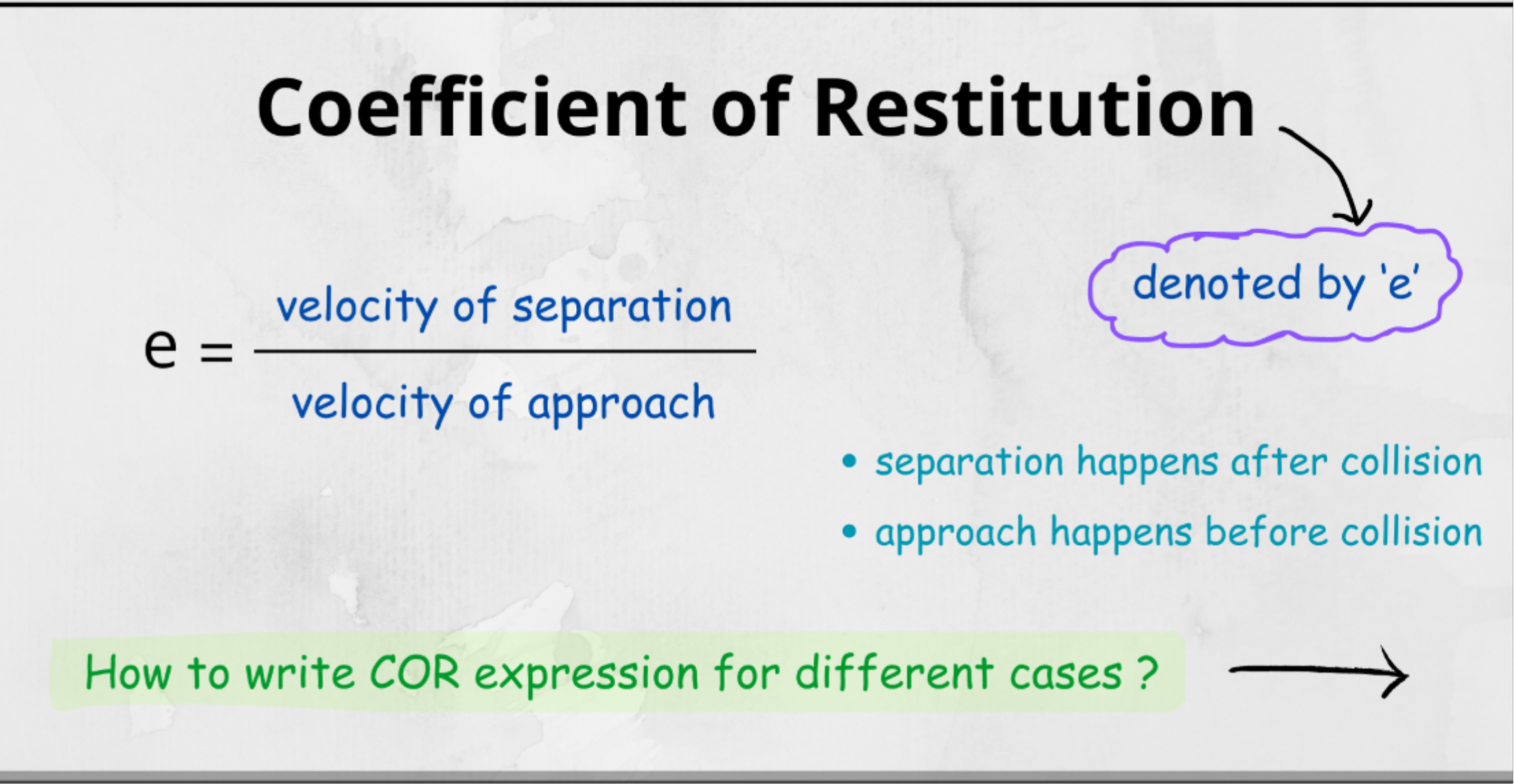
How to write Coefficient of Restitution expression ? – Part 1

(Use Desktop/Laptop for better Experience)

Topic Under Chapter – Center of Mass and Collisions

Coefficient of Restitution also called in short as COR is one of the important concepts to be taken into consideration when it comes 

in designing sports equipments like badminton racquet, tennis racquet, several types of balls like baseball, basketball, cricket

ball ,etc. 

  • This is mainly because of the fact that these sports like basketball, badminton, tennis, etc involve collisions which makes terms like collision energy and rebound energy come into picture. To relate how good the bounce will happen, we have a ratio known as ‘Coefficient of Restitution’. As simple as that !

1. Rules to Remember

There are 2 cases :

  • Before collision (Deals with the Approach of the bodies)
  • After Collision (Deals with the Separation of the bodies)


Remember This !
For Before Collision (Vapp) : The velocity component which supports the approach i.e. that component feels as if bodies should approach each other, is positive

Remember This !
For After Collision (Vsep) : The velocity component which supports the separation i.e. that component feels as if bodies should get separated from each other, is positive

2. Examples (Different Cases for COR) :

We have 2 bodies (body 1 and body 2) undergoing collision. We will be trying to write the Coefficient of Restitution for each case.

Case 1 :

Writing Velocity of approach (Vapp) first :

  • Both u1 and u2 want the approach of the bodies to happen. So both will be positive. Hence Vapp is ‘u1+u2’

Writing Velocity of separation (Vsep) :

  • v1 and v2, both want separation to happen. So, +v1 and +v2. Hence Vsep will be ‘v1 + v2’
Case 2 :

Writing Velocity of approach (Vapp) first :

  • u1 wants approach but u2 doesn’t want that. So, +u1 but -u2. Hence Vapp is ‘u1-u2’

Writing Velocity of separation (Vsep) first :

  • v1 wants to separate but v2 doesn’t want that. So, +v1 but -v2. Hence Vsep is ‘v1-v2’
Case 3 :

Writing Velocity of approach (Vapp) first :

  • Both u1 and u2 want the approach of the bodies to happen. So both will be positive. Hence Vapp is ‘u1+u2’

Writing Velocity of separation (Vsep) first :

  • v2 wants to separate but v1 doesn’t want that. So, -v1 but +v2. Hence Vsep is ‘-v1+v2’
Case 4 :

Writing Velocity of approach (Vapp) first :

  • u1 wants approach but u2 doesn’t want that. So, +u1 but -u2. Hence Vapp is ‘u1-u2’

Writing Velocity of separation (Vsep) first :

  • v1 and v2, both want separation to happen. So, +v1 and +v2. Hence Vsep will be ‘v1 + v2’

FAQ section :


What is Coefficient of Restitution ?

Coefficient of Restitution or COR is the Ratio of the Rebound speed (velocity of separation) to Collision Speed (velocity of approach). It helps in determining the intensity/type of collision that can take place


How is elastic and inelastic collision determined by COR ?

If value of Coefficient of Restitution (COR) is 1, it implies that the collision is elastic in nature i.e. no kinetic energy will be lost during collision. If the COR is <1, it implies partially elastic while if COR is 0, then collision is called ‘perfectly inelastic’

String-Pulley Constraint Relations

String Pulley Constraints are very commonly used in high school physics and mainly comes under Newton’s Laws of motion (NLM). This concepts are frequently asked in exams such as JEE Mains and even JEE Advanced !! 

Time becomes an important factor in such competitive examinations, especially JEE Mains. So, it’s always better to have some short tricks to be faster and save time. But, still, I would like to emphasize on the fact that concept>>tricks


How to apply ?

Remember the rules :

  • Only one string at a time
  • On the string –> ‘minus’ sign (Recall the -ve charge sign on ions from chemical bonding because that’s how I kept it in my mind)
  • Away from the string –> ‘plus’ sign
How to use it in problems ? (Have patience…Lot of things are about to get easier for you)

Steps :

  1. Mark the points on the string such that whole string is covered (starting to end)
  2. For pulleys, mark for the points- where the string first comes in contact with the pulley (pt 2) and where the string leaves the contact with pulley (pt 3)
  3. Now start from one end,( say pt1) . The relation will be as follows (-Va + 0 + 0 +Vb) 

Why ?

-Va because Va is going on the string

+0 because pt2 is connected to pulley and pulley is at rest

+0 pt3 is connected to pulley and pulley is at rest

+Vb because pt4 is connected to block B and Vb is going away from the string

      4.  Finally equate everything to zero i.e. (-Va + 0 + 0 +Vb = 0)

Final Answer : We get Va  = Vb


Easy Examples

Q.1 Write down the constraint relation between velocities of block A and block B by referring the image of setup alongside.

Solution :

Constraint relation can be written as : (Applying trick, starting from block A)


Q.2 Write down the constraint relation between velocities of block A and block B by referring the image of setup alongside.

Solution :

We start from block A (Just move along the string one-by-one) :


Q.3 Write down the constraint relation between velocities of block A and block B by referring the image of setup alongside.

Solution : Let’s start from block A


Moderate to Difficult Examples

Solution : Part(a) –

 (Lets start from the point near the rigid support)

Part (b) :  Again we start from the point attached to the rigid end 

(Note that the derivative of velocity wrt time is acceleration. So once you get the velocity constraint relation, just taking its derivative wrt time will give you the constraint relation for accelerations)


Q. Give the constraint relations between block A and block B in the setup shown in image alongside 

Solution:

Recall that this trick can only be applied to one string at a time !

So, we take velocity of pulley X as Vx as shown in figure below and we start applying trick from block A end

But, we need relations between Vb and Va


Q. Next Example :

Solution : 

As we discussed, only the velocity component along the string are to be considered

Starting from star (*) mark

Same approach, mark all the points  on the string first

But, we know that the value of Vb (RHS) from the above expression is always going to be positive since 

So, the assumed direction of Vb (upwards) is also correct !


Conclusion :

So, over here, we end this article. Do practice some more string pulley constraint problems using this trick. But also don’t miss out on the actual procedure. Tricks should always be your secondary option !!

 We will keep coming up with more such articles to help you in your preparation !! Thank you for your time.

Have a good day!