Pulley Block Problems are very common in high school physics and mainly come under Newton’s Laws of Motion (NLM) chapter. You can find a lot of them in HC Verma Sir’s Concept of Physics book. These concepts are frequently asked in exams such as JEE Mains and even JEE Advanced.
Time becomes an important factor in such competitive examinations, especially JEE Mains. So, it’s always better to have some short tricks to be faster and save time. But, still, I would like to emphasize the fact that concept>>tricks
Pulleys are often referred to as simple machines because it makes lifting loads easier by either changing the direction of force or reducing the required input force through mechanical advantage. We will exactly learn the same in this article through equations in this blog.
Rules to apply the Trick:
Remember the rules :
- Only one string at a time
- On the string –> ‘minus’ sign (Recall the -ve charge sign on ions from chemical bonding because that’s how I kept it in my mind)
- Away from the string –> ‘plus’ sign
How to use this trick in solving pulley block problems?
Steps:
- Mark the points on the string such that whole string is covered (starting to end)
- For pulleys, mark for the points- where the string first comes in contact with the pulley (point 2) and where the string leaves the contact with the pulley (point 3)
- Now start from one end ( say point 1). The relation will be as follows (-Va + 0 + 0 +Vb)
Why?
-Va because Va is going on the string
+0 because point 2 is connected to the pulley and the pulley is at rest
+0 point 3 is connected to pulley and pulley is at rest
+Vb because point 4 is connected to block B, and Vb is going away from the string

Finally equate everything to zero i.e. (-Va + 0 + 0 +Vb = 0)
Final Answer: We get Va = Vb
Easy Examples based on Pulley Problems
Q.1 Write down the constraint relation between velocities of block A and block B by referring the image of setup given below

Solution :

Constraint relation can be written as : (Applying trick, starting from block A)
\(\displaystyle -v_A + 0+0+v_B+v_B+0+0+0 = 0\)
Shown below is the breakdown of what each term in the above expression represents:
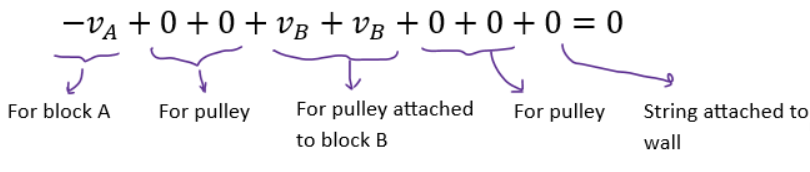
On simplifying, we get:
\(\displaystyle v_A = 2v_B\)
Q.2 Write down the constraint relation between the velocities of block A and block B by referring to the image of the setup alongside.

Solution: We start from block A (Just move along the string one-by-one):
\(\displaystyle -v_A + 0+0+v_B+v_B+0 = 0\)
\(\displaystyle v_A = 2v_B\)
Q.3 Write down the constraint relation between velocities of block A and block B by referring the image of setup alongside.

Solution : Let’s start from block A
We start from block A (Just move along the string one-by-one):
\(\displaystyle -v_A + 0+0+v_B+v_B+0 = 0\)
\(\displaystyle v_A = 2v_B\)

Moderate to Difficult Examples on Pulley Block Problems
Question 4:
The figure alongside shows a system of four pulleys with two masses, A and B. Find, at an instant:
(a) Speed of block A when the block B is going up at 1 m/s and pulley Y is going up at 2 m/s.
(b) Acceleration of block A if block B is going up at 3 m/s² and pulley Y is going down at 1 m/s².
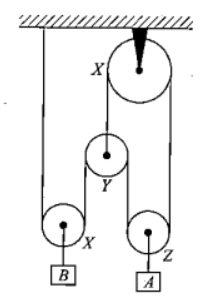
Solution:
Part (a) :
(Lets start from the point near the rigid support)
The constraint relation can be written as:
\(\displaystyle 0-1-1+2+2+v_A+v_A+0+0-2 = 0\)
\(\displaystyle 2v_A = 0\)
\(\displaystyle \therefore v_A = 0\)

Part (b) : Again we start from the point attached to the rigid end
(Note that the derivative of velocity wrt time is acceleration. So once you get the velocity constraint relation, just taking its derivative wrt time will give you the constraint relation for accelerations)
The constraint relation can be written as:
\(\displaystyle 0-3-3-1-1+a_A+a_A+0+0+1 = 0\)
\(\displaystyle 2a_A = 7\)
\(\displaystyle \therefore a_A = 3.5 \, \text{m/s}^2\)
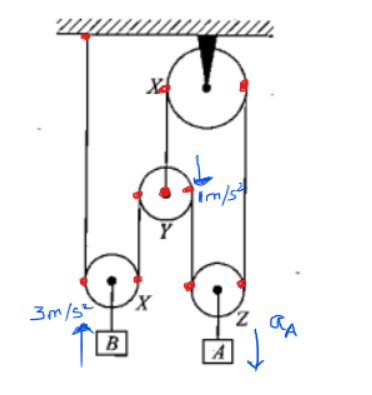
Question 5:
Write the constraint relations between block A and block B in the setup shown in the image alongside

Solution:
Recall that this trick can only be applied to one string at a time!
So, we take velocity of pulley X as Vx as shown in figure below and we start applying trick from block A end
The constraint relation can be written as:
\(\displaystyle v_A+0+0+0+0+0+0+0+v_X+v_X = 0\)
\(\displaystyle 2v_X=-v_A \)

But, we need relations between VB and VA
The constraint relation can be written as: (Starting from block B)
\(\displaystyle v_X=-v_B\)

On Substituting vX value to get the relation between the velocity of A and the velocity of B,
We get,
\(\displaystyle v_A= 2v_B\)
Question 6:
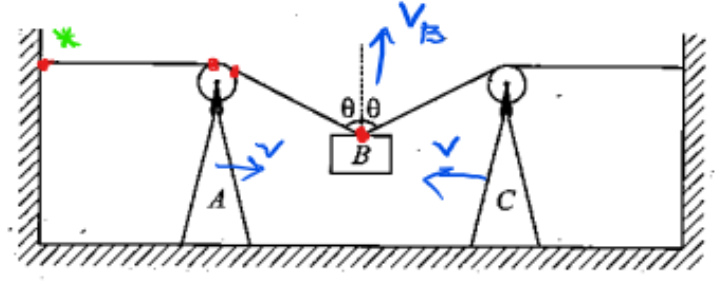
Find the speed of block B when the wedges A and C are moving toward each other with speed v and the strings connected to block make an angle θ with the vertical, as shown in the figure alongside
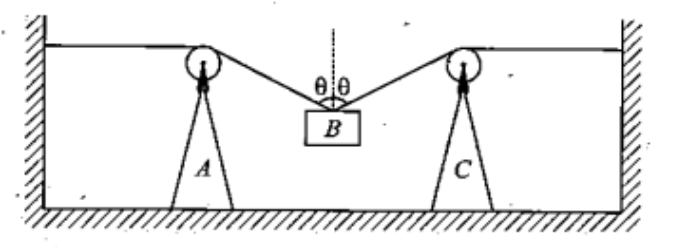
Solution:
As we discussed, only the velocity component along the string are to be considered
Starting from the green colored star (*) mark
Same approach, mark all the points on the string first
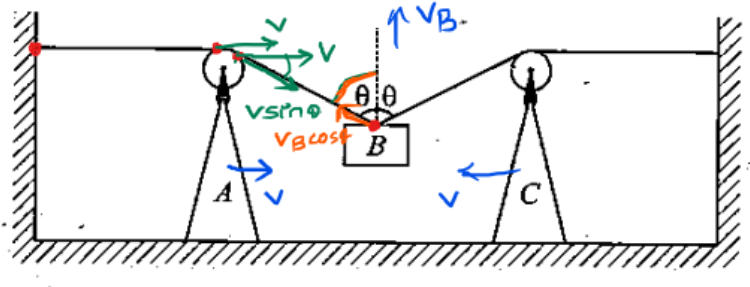
The constraint relation can be written as: (Starting from block B)
\(\displaystyle 0 + v – v \sin \theta – v_B \cos \theta = 0\)
\(\displaystyle v_B = \frac{v(1 – \sin \theta)}{\cos \theta}\)
But, we know that the value of VB (RHS) from the above expression is always going to be positive since,
\(\displaystyle -1 \le \sin \theta \le 1\)
So, the assumed direction of VB (upwards) is also correct!
Conclusion :
So, over here, we end this article. Do practice some more string pulley constraint problems using this trick. But also don’t miss out on the actual procedure. Tricks should always be your secondary option !!
We will keep coming up with more such articles to help you in your preparation !! Thank you for your time.
Have a good day!