What is a machine ? 3 idiots definition breakdown

What is a machine - definition breakdown

Author – Saurabh Salvi

One of my favourite scene from ‘3 idiots’ movie is when Rancho is asked the definition of ‘Machine’ by his Professor. And we all know what he answers and we all love that explanation but professor didn’t seem to like that simplified version of his. Instead, he was much impressed by the definition given by Chatur and most of us (actually, all of us) just skipped that definition part.

What is a machine - 3 idiots movie scene (Rancho)
What is a machine - 3 idiots movie scene (Chatur)

Ofcourse, it’s not a great idea to mug up things without understanding (we have already discussed this point in Understanding Projectile Motion), but the definition of machine which he gives is also quite impressive. It goes something like this :

Definition :

“Machines are any combination of bodies so connected that their relative motions are constrained and by which means, force and motion may be transmitted and modified as a screw and its nut, or a lever arranged to turn about a fulcrum or a pulley about its pivot, etc. especially, a construction, more or less complex consisting of a combination of moving parts, or simple mechanical elements as wheels, levers, cams etc.”

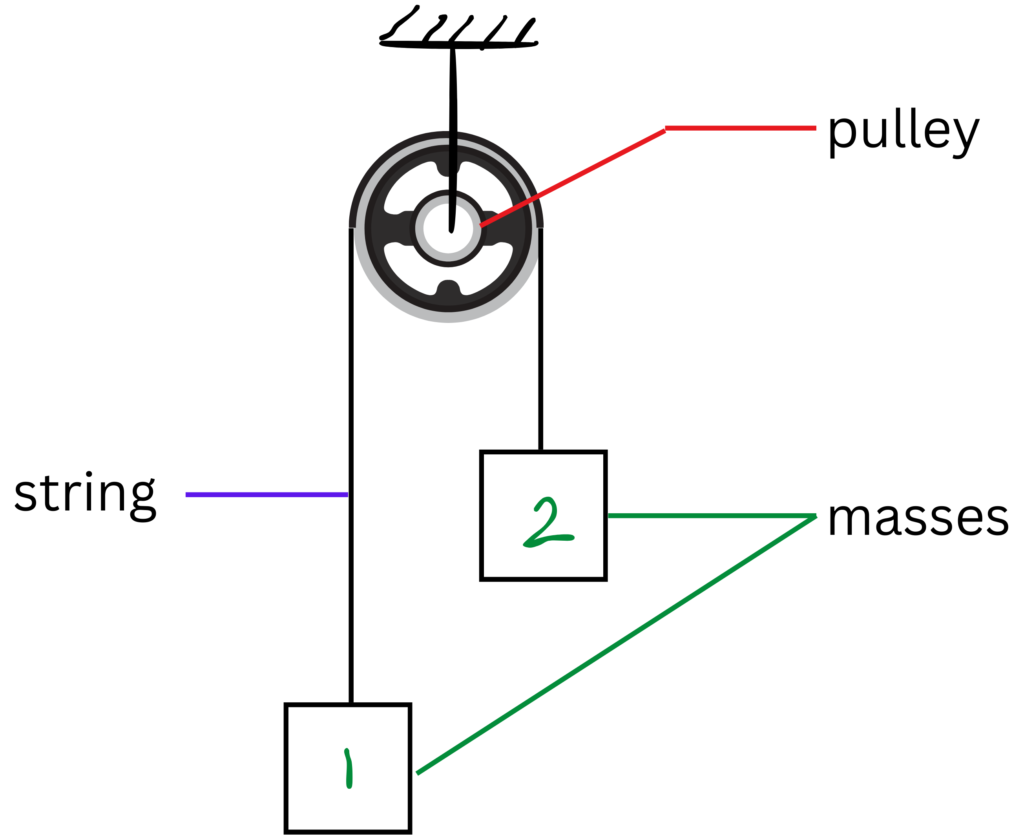
In today’s blog, we will be breaking this definition down with the help of a very simple example which most of us (from PCM or PCB background) have studied i.e. Atwood machine – the simplest pulley-block system

Let’s divide the definition in parts and try to get this thing sorted out quickly :

1st part – “Machines are any combination of bodies so connected that their relative motions are constrained

Look at body 1 and 2. Both the masses are so connected that their motions are dependent on one another. That’s what we call as – ‘the relative motion is constrained’

We can write the constraint relation for displacement between the two masses for this case as :

*Refer to this article for a detailed discussion on writing constrained relations : Click Here

It shows that if 1 comes down by ‘x’ metre, then 2 has to move up by ‘x’ metre. It’s all constrained !


2nd part – “and by which means, force and motion may be transmitted

The gravitational force on 1 (m1*g) is transmitted through the string to affect the motion of 2.

Also, if 1 and 2 are of same mass, they don’t have any acceleration but in case the masses are different the accelerations of 1 and 2 get modified

We write FBD (free body diagram) equation for each body as :

What is a machine ? - pulley

3rd part – “as a screw and its nut, or a lever arranged to turn about a fulcrum or a pulley about its pivot, etc.

This part explains about various examples of simple machines (screw-nut, lever, pulley).

Here, in this examples, we have pulley as a simple machine component as a part of this whole system.


4th part – “especially, a construction, more or less complex consisting of a combination of moving parts, or simple mechanical elements as wheels, levers, cams etc.

Compared to a simple machine like pulley, we can say that Atwood machine system arrangement would come under a complex combination which has many moving parts in it such as :

  • Masses
  • String
  • Pulley

This was a short and fun kind of post just to make sure that all of the 3 idiots movie lovers can now breakdown this definition the next time they watch the movie! My aim was to explain this thing in the simplest way possible.

Also, I would like to add that just memorizing blindly doesn’t make any sense but understanding the definition would really help us to make our grip on the concepts much more better. I would also be quite impressed if Chatur had the understanding of this beautiful definition. But sadly, the character ‘Chatur’ doesn’t seem to be interested in all this 🙁

Keep Learning!


Physics & Electronics

How does a Multigrade Oil help in Car Engine ?

We all have seen engine oil can somewhere, and most commonly at the mechanics shop. How you ever wondered about what’s this 5W-30 written on it ? Well, that’s what we are going to find out through this article

Topics Covered :

  • Short Introduction to viscosity
  • Temperature effect on viscosity
  • Need for Multigrade Oil

1. Short Introduction to viscosity

Let’s say you have water flowing over a flat plate. For sure, it’s not going to move freely. But, why do we say that ? The answer to this is : Viscosity. In simpler words, there is a kind of internal friction among the moving layers of the fluid. This resistance doesn’t let the fluid flow freely over the plate.

You can say that : ‘Friction loves keeping all the layers together’. In technical terms, we say : “Friction opposes relative motion”. Having this understanding, consider layer number 2. 

  • Layer 3 moves at a faster speed (v+dv) than 2. Hence, viscous force on lower layer of 3 acts in such a way that it gets slowed down. 
  • Layer 1 moves at slower speed (v-dv) than 2. Hence, viscous force on upper layer of 1 acts in such a way that it gets faster.

This fluid property of trying to keep and move the fluid ‘together’ is known as Viscosity.

The thing which separates the low viscous fluid from the highly viscous fluid is the amount of ‘strictness’ that the fluid shows for keeping them together.

Honey
Water
  • For example, water is less viscous than honey because water doesn’t care much about keeping the layers moving together. While, Honey is like a much ‘strict master’ who wants all of this layers to be united/together

Technical Definition for Viscosity –
The measure of resistance to relative motion within the fluid is called viscosity

2. Temperature effect on Viscosity

Effect of Temperature

Temperature does have an effect on viscosity of the fluid.

  • In case of a liquid, the molecules are bonded by a weak chemical bonds. 
  • On increasing temperature, you are actually providing enough thermal energy to the molecules that they break the bonds and become free. This causes the viscosity of fluid to decrease as there is no more dependency of fluid layers on one another because of moving apart. We say, the fluid becomes thinner.
  • While, at much lower temperatures, the fluid tends to become thicker.

3. Need for Multigrade Oil

Engine Oil is mostly used in order to ensure that there is proper lubrication among the contact parts i.e. with engine oil, we ensure there is no wear and tear among the interacting parts. 

3.1 What happens if oil is too thin or too thick ?

  • If the oil you use is too thin, it will just flow out of the surfaces very quickly and hence won’t be of any help

  • If the oil is too thick, a lot of power would go into just moving the parts through your ‘thick’ oil

3.2 Effect of Temperature on motor oil ?

So, knowing this, we choose a motor oil with some given viscosity. Now, consider 2 cases :

  • Case 1 : I use this oil in peak summer days
  • Case 2 : I use this oil in peak winters

We have already discussed about the effect of temperature on the viscosity. An oil with given viscosity would becomes thinner in peak summer and thicker on peak winters.

SOLUTION :
To overcome this, earlier people used a 30-weight motor oil (already thicker) in summers, so that, it thins out and reach required value because of high temperature WHILE they used 5-weight motor oil (already thin) in winters, so that, it thickens to reach the required value in peak winters due to low temperature.

BUT Now, we have come up with something even better, known as ‘Multigrade Oil‘. 

The speciality of this oil being that it can maintain a constant value of viscosity over a wide range of temperatures. Hence, we no longer have to change our oil from season to season. 

  • The key feature of multigrade oils is their ability to remain fluid when cold and provide adequate viscosity at higher temperatures.

Rating :

5W-30 means 5 weight in winter and 30 weight in summer. Hence, viscous nature remains maintained. Now, you know the reason behind 5W-30. Similarly, we also have 10W-40 and many more…

More Articles to Read :


How to write Coefficient of Restitution expression ? – Part 1


29 August 2024

Blog

No Comments

Writing expression of Coefficient of Restitution (COR) can be a bit confusing. Also COR is one of the important concepts when it comes to designing sports equipments like racquets and balls


What is Total Internal Reflection ? – Geometrical Optics


24 August 2024

Blog

No Comments

Total Internal Reflection, shortly known as TIR is one of the useful phenomenon in Geometrical or Ray Optics which has applications in lot of areas. In this Article, we discuss this topic in detail


Problem 7 : Red or Blue ?


14 August 2024

Blog

No Comments

Physics Problem 7 – It mixes up Physics and Electronics. But not only that, the physics part itself consists of multiple concepts


Charge Induction in Metals and Non-metals


21 July 2024

Blog

No Comments

Charge Induction is a topic under Electrostatics. The article describes the process of how actually charges get induced onto the surface of conducting and non-conducting bodies

GPS Working

For Best Experience, View on Desktop/Laptop

In this specific article, we are going to learn about the working of GPS. In the upcoming articles, we will be dealing with the interfacing of of GPS module with the Arduino. I feel that it’s important to know the working of the module which we use in our project instead of just learning about ‘how to make the module throw it’s data values at us”…..

GPS stands for Global Positioning System and is mainly used to locate the exact location of the receiver with the help of data which it gives (out of which most important is Longitude and Latitude coordinates)

Working :

– The working of the GPS module is based on the communication between the satellites and the GPS receiver module.  For locating the position of a place on earth, we need several parameters like Longitude and Latitude (2-D) and an extra Altitude (for 3-D)

– To locate the position, in GPS, we have something known as Trilateration.

 In 2-D

 we need a total of 2 satellites (say S1 and S2 here). We    are suppose located at point O and we need our location through GPS.

                                                                                   Fig. Determination of position in 2-D

– This implies that, O is somewhere on the region common to circle-1 and circle-2. This means it lies in the points of intersection of circle      1  & 2 (here O and P).

– To decide between O and P, we take into account the circle-3 which is the earth surface itself. All the 3 circles intersect at O (therefore, P is eliminated) and hence we obtain the position of a GPS receiver in 2-D.

In 3-D,

– We need a total of 3 satellites for locating position of GPS receiver

Here, we need to consider just the spheres instead of circle. 

For quick overview,

But, there exists a problem of time delay, since the satellites have accurate atomic clocks while the GPS receivers uses the clocks which are installed in mobile phones.

But since all the satellites use the same specifications for atomic clock, the ‘time offset’ is the same. Even error of microseconds can give an error in kilometers !! Hence we use fourth satellite (S4).

As we discussed earlier, that we need the distance ‘d’ for locating the positions of satellites. 

  • But HOW DO WE EXACTLY DETERMINE ‘d’ ?

The ‘radio signal’ which is sent, it carries 2 information mainly :
          – Exact time when it was transmitted (t1)
          – Position of satellite

Now the receiver receives the signal at time t2 (say) :

The below is about What happens inside the GPS receiver (mainly a topic of discussion for our next Article)

Keep Learning !!