In Part-1, we already got an idea about the functioning of the capacitors. But now, with that understanding, how to make use of them in electric circuits?
This is what we focus on in this article. Getting inclined towards the numerical aspect of the capacitors is our goal for this article.
- 1. Understanding Capacitance
- 2. Reading Values of Capacitor:
- 3. Checking Working Voltage or Rated Voltage of a Capacitor:
- 4. Clearing the basics
- 5. Parallel Plate Capacitors
- 6. What is a dielectric, and what is its use?
- 7. Series Combination in Capacitors
- 8. Parallel Combination in Capacitors
- 9. Methods to simplify the circuits
- 10. Special equivalent capacitance problem :
- Conclusion:
1. Understanding Capacitance
Capacitance is the ability of the body to store charge.
But this ability itself depends on 3 things:
- Surface area of the metal plates
- Type of dielectric which we are using between the plates
- Distance between the plates
- Unit of capacitance : farad (F)
- 1F implies that the capacitor has the ability to store 1C of charge on each plate (+1C and -1C) when 1V of potential difference is applied across it.
For example, we have 2 capacitors. 1st has a capacitance of 2F and 2nd has a capacitance of 10F. Which has more capacitance ?
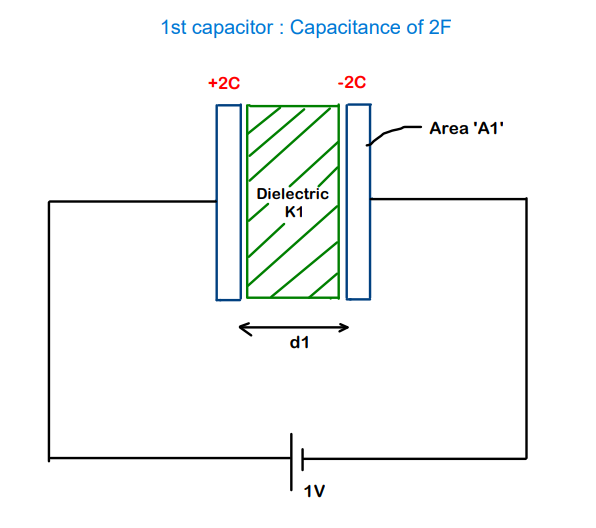
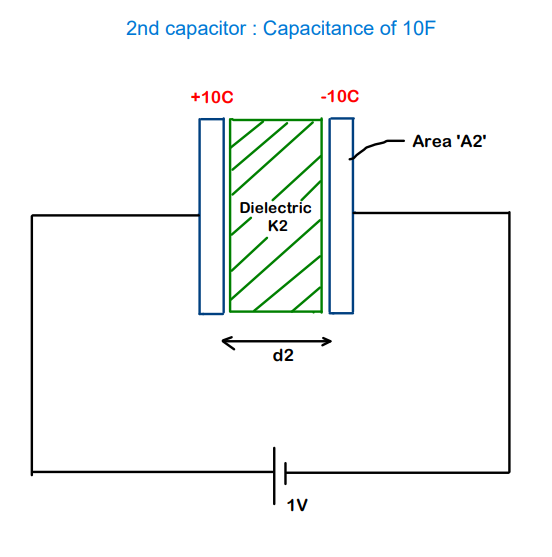
For the 2F capacitor, we can store 2C charge on plates with the potential difference of 1V. But for the same potential difference of 1V, we can store 10C of charge in case of 10F capacitor. So obviously, 10F is a capacitor of higher capacitance than 2F
Note:
- We can observe that the area of the plates, the distance between the plate and the dielectric are different for both. It is not possible to have different capacitances with the same 3 parameters. At least one of them should differ!
For example,
- You need to store 5 laddus in a given container. On keeping all the laddus, You find the container is fully filled.
- Next, you are asked to fill 10 laddus in a container of your choice. You won’t choose the previous container; instead, you would choose the one with larger dimensions -> since it gives more capacity!

2. Reading Values of Capacitor:
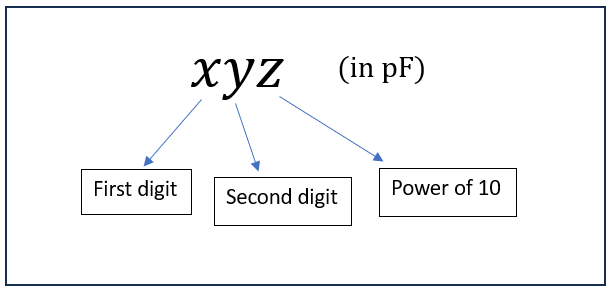
We have a three-digit marking system for mica disc capacitors. Note that, this gives the capacitance value in pF (picofarads). Refer to the picture below.
- The first number represents the first digit of the capacitance value
- The second number represents the second digit of the capacitance value
- The third number represents the power of ten
For example,
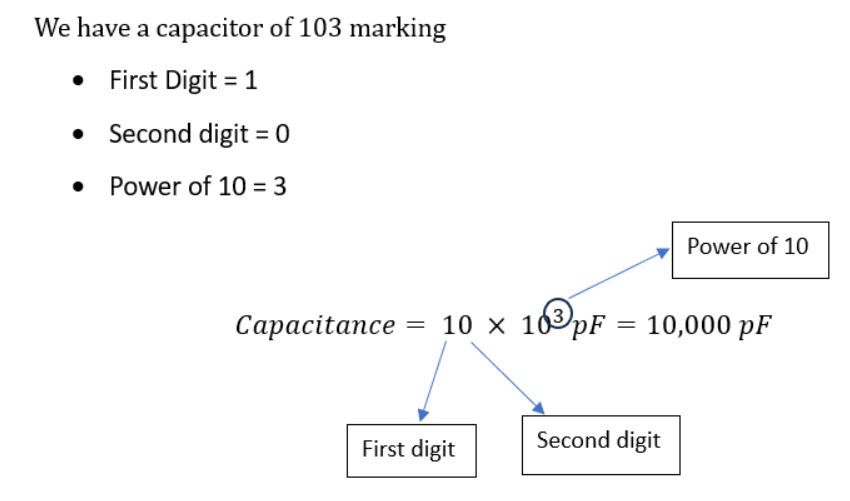
We have a capacitor of 103 marking on it
- First digit for capacitance = 1
- Second digit for capacitance = 2
- Power of ten = 3
Hence the value of the capacitance will be 10e3 pF or 10,000 pF

3. Checking Working Voltage or Rated Voltage of a Capacitor:
Often, you will also see one more value in addition to the capacitance. It is usually given in V (volts). This is nothing but the ‘Working voltage’ and also known as ‘Rated Voltage’.
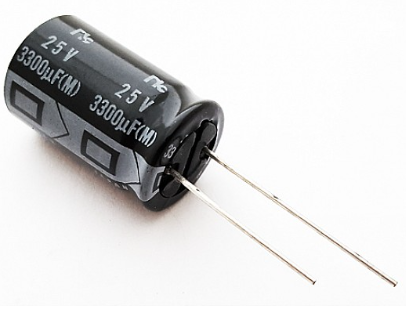
Your capacitor should atleast have a working voltage which is 10-15 % higher than the supply voltage in your circuit. This keeps your circuit safe and also keeps you safe !!
Precaution: Take Care of Polarity!
Some Capacitors are polarized which means that, the way you insert them/connect them to the circuit matters a lot !
- The positively marked terminal should be kept at a higher voltage than the negative terminal
Usually, the manufacturers keep a separate band which directs the user towards the negative terminal of polarized capacitor.
4. Clearing the basics
As discussed in part-1, the more the charge separation happens (+Q on one plate and -Q on the other), the greater the potential difference across the plates of the capacitor(V). So basically we can say,
\(\displaystyle Q \propto V\)
Now we introduce the ‘constant’ of proportionality –> Capacitance (C). The relation becomes:
\(\displaystyle C = \frac{Q}{V}\)
Note that :
- Increasing the charge doesn’t increase the capacitance of the capacitor as it may appear in the above equation. For simplicity, remember it as –> Once a capacitor is made, its capacitance value is stamped on it !!
- Instead, capacitance is decided by the physical dimensions and the dielectric used. (For understanding, once the vessel is manufactured, it has some dimensions to it, and based on those dimensions, you can decide the capacity of the vessel.)
5. Parallel Plate Capacitors
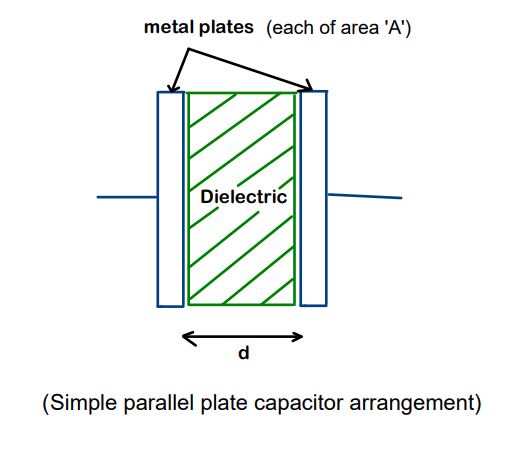
There are many configurations possible to make a capacitor, but the simplest one to analyze is the Parallel plate Capacitor. This setup basically consists of :
- 2 metal plates of area ‘A’ kept at a distance ‘d’ apart from each other
- Dielectric medium (of dielectric constant ‘k’) inserted between the plates
- Important Condition : (A>>d)
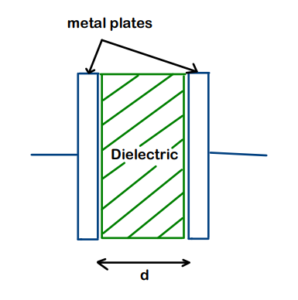
The capacitance of the parallel plate capacitor is given by:
\(\displaystyle C = \frac{A \epsilon_o K}{d}\)
We can clearly verify from the above expression that the capacitance just depends upon the geometrical factors and the dielectric constant.
6. What is a dielectric, and what is its use?
“In simple words, dielectrics are a type of insulating materials which allow Electric field but doesn’t allow an electric current to pass through them.”
They are mainly used to serve 3 purposes:
- Dielectric acts as an insulating material which maintains the gap between the plates
- It increases the max. voltage that can be applied across the capacitor plates without getting breakdown
- It increases capacitance of capacitor
3.1 Maintaining Gap
It is necessary to maintain the gap (even though small) between the metal plates. Because the capacitor would lose all of its storing capacity if the metal plates come in contact with each other, since in that case, it would just behave as a simple conductor.
3.2 Increasing the maximum voltage without breakdown
Dielectric Breakdown:
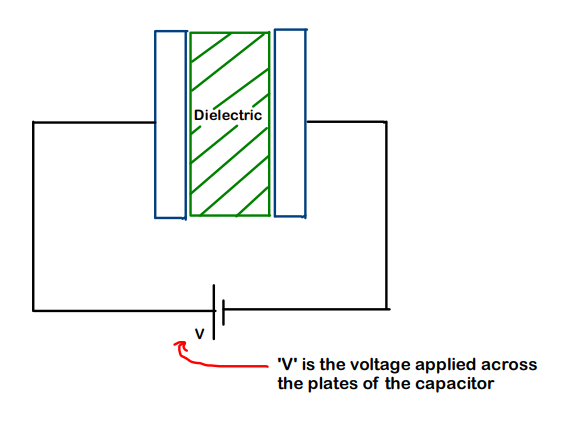
- Each dielectric material has its own breakdown voltage.
- If the applied voltage becomes greater than the breakdown voltage of the dielectric material, the atoms start to get ionized, and we know that ions do conduct electricity.
- Because of this, the whole capacitor starts to act as a conductor
The better the dielectric material, the higher the dielectric breakdown voltage. Let’s consider 2 situations :
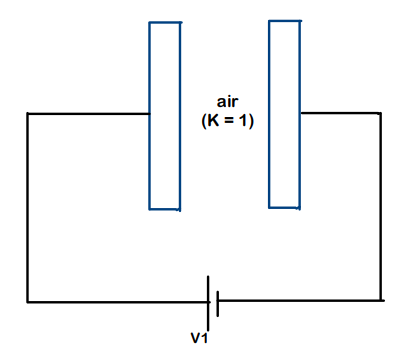
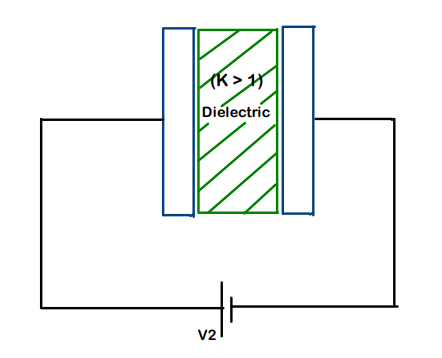
The dielectric breakdown voltage of the material (say D2) is more than that of air. This implies that more voltage across the capacitor plates is required in the case of D2 for the breakdown to happen. This proves our point that the insertion of a dielectric allows us to apply more voltage across the capacitor plates without causing any dielectric breakdown.
3.3 Increasing Capacitance
Suppose we have a capacitor with just air between the plates. Now we insert a dielectric material of dielectric constant ‘k’ between the plates completely. Have at the look at the flowchart below to just get a quick overview of what happens!
7. Series Combination in Capacitors
“Like the way we have current in case of resistors, in the same way, for capacitors, we have charge.”
- For Capacitors to be said in a series combination, the charge flowing through them should be the same.
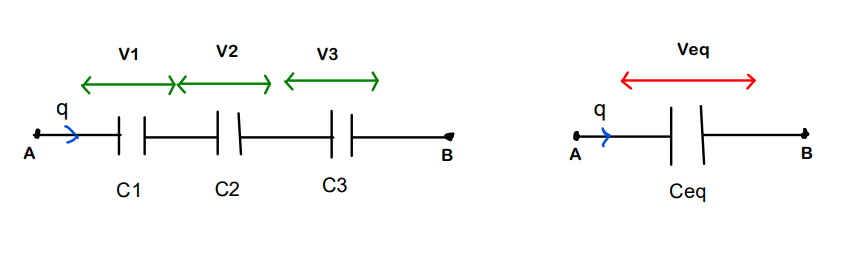
Consider 3 capacitors C1, C2, and C3 in series combination, and V1, V2, and V3 are the potential differences across them, respectively.
Since we need to find the ‘equivalent’ capacitance:
\(\displaystyle V_{\text{eq}} = V_1 + V_2 + V_3\)
\(\displaystyle \frac{q}{C_{\text{eq}}} = \frac{q}{C_1} + \frac{q}{C_2} + \frac{q}{C_3}\)
But the charge flowing through all is still the same. Hence, we get:
\(\displaystyle \frac{1}{C_{\text{eq}}} = \frac{1}{C_1} + \frac{1}{C_2} + \frac{1}{C_3}\)
So, we can observe that, by keeping capacitors in series, we get the value of equivalent or resultant capacitance, which is even less than the one that has the least capacitance among the three. Suppose, C2 < C1 < C3, then Ceq < C2
8. Parallel Combination in Capacitors
Again: “Like the way we have current in case of resistors, in the same way, for capacitors, we have charge.”
- For the Capacitors to be in Parallel, the potential difference across all should be the same.
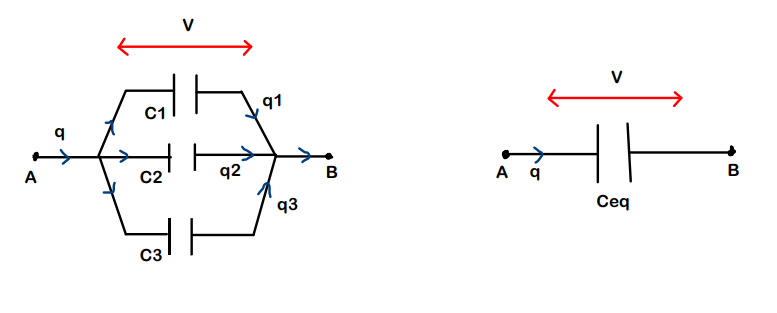
Consider 3 Capacitors C1, C2, and C3 in parallel combination, and the charges passing through them are q1, q2, and q3, respectively.
We know the relation from KCL:
\(\displaystyle q = q_1 + q_2 + q_3\)
\(\displaystyle C_{\text{eq}}(V) = C_1(V) + C_2(V) + C_3(V)\)
But the potential difference across all is still the same. So, we get:
\(\displaystyle C_{\text{eq}} = C_1 + C_2 + C_3\)
The equivalent capacitance incase of a parallel combination will be greater than the greatest among the three (here)
9. Methods to simplify the circuits
Now, there are again some types of network circuits in which we are expected to find the equivalent Capacitance.
There are several methods to simplify and solve such type of circuits, like :
- Mirror Symmetry
- Folding symmetry
- Voltage method (Rearrangement)
We have already looked at the above methods with context to resistors in Combining Resistors: Series, Parallel & Equivalent Resistance
Though the article is for Resistors, the approach of simplifying the circuit/network still remains the same!
10. Special equivalent capacitance problem :
Example: Find the equivalent capacitance across points A and B
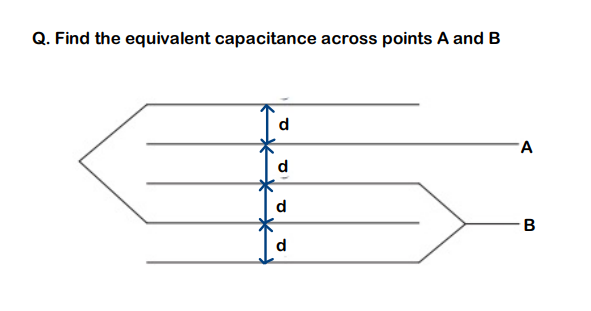
Step-1 :
Distribute the voltages across all plates. In this example, we consider the voltage/potential at A to be ‘a’ and at B to be ‘b’. Still, we are not able to cover all the plates. So we introduce another unknown potential ‘x.’
Remember that: Potential always remains constant on a conductor

Step-2 :
Assign the numbers to each face of the plates
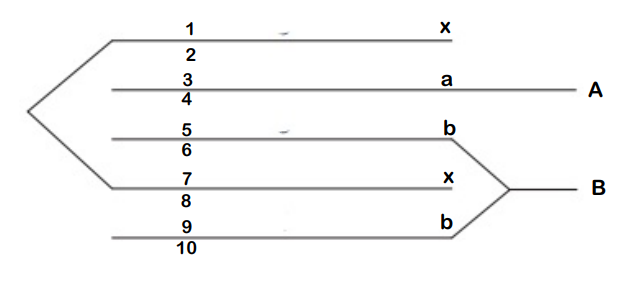
Step-3 :
Keep points ‘a’ and ‘b’ at the ends, and all the unknowns which we introduced should come in between.
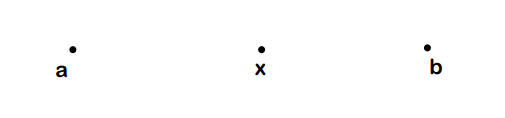
Step-4 :
To make a capacitor, we need 2 plates and separate them by a distance
- Faces 2 and 3 make a capacitor
- Faces 4 and 5 make a capacitor
- Faces 6 and 7 make a capacitor
- Faces 8 and 9 make a capacitor
So, now, we just look at the numbers assigned to their faces and make a simplified circuit.

Step-5 :
Solve by normal Series- Parallel concepts
The equivalent capacitance of the simplified circuit is 5C/3, where C is :
After you solve the examples given in this article on your own, it’s time to level up. Try to solve this PDF in order to get more exposure to a variety of problems based on capacitors.
Conclusion:
So, with this, we are done studying about combining the given capacitances in various patterns to get the required capacitance in our circuit. By combining two key components – resistors and capacitors, we can unlock a wide range of possibilities for circuit development. Understanding these two components equips us to design many exciting circuits. We will explore this further in our upcoming articles.
Till then, Keep Learning!
Complete Guide on Capacitors:
- Part-1: Capacitors explained with Analogies | Charging and Discharging
- Part-2 (You are here): Dielectrics and Equivalent Capacitance