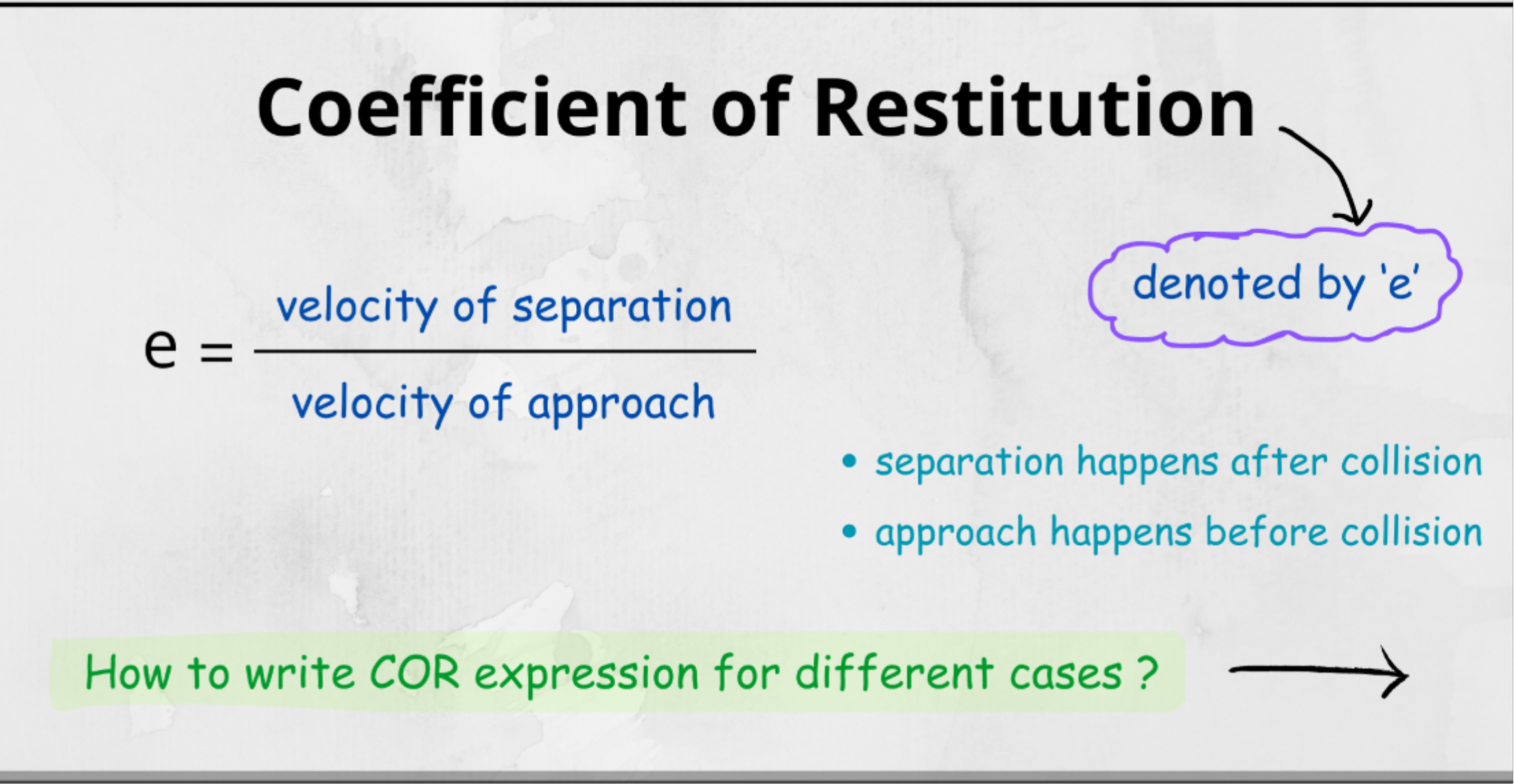
Topic Under Chapter – Center of Mass and Collisions
Coefficient of Restitution, also called COR, is one of the important concepts to be taken into consideration when it comes to designing sports equipment like badminton racquets, tennis racquets, and several types of balls, like baseball, basketball, and cricket ball, etc.
- This is mainly because of the fact that these sports like basketball, badminton, tennis, etc. involve collisions, which makes terms like collision energy and rebound energy come into the picture. To relate how good the bounce will be, we have a ratio known as the ‘Coefficient of Restitution’. As simple as that!
1. Rules to Remember
There are 2 cases :
- Before collision (Deals with the Approach of the bodies)
- After Collision (Deals with the Separation of the bodies)
For Before Collision (Vapp): The velocity component that supports the approach, i.e., that component that feels as if bodies should approach each other, is positive.
For After Collision (Vsep): The velocity component that supports the separation, i.e., that component that feels as if bodies should get separated from each other, is positive.
2. How to use the expression of coefficient of restitution?
We have 2 bodies (body 1 and body 2) undergoing a collision. We will be trying to write the Coefficient of Restitution for each case.
Case 1:

Writing Velocity of approach (Vapp) first :
- Both u1 and u2 want the approach of the bodies to happen. So both will be positive. Hence, Vapp is ‘u1+u2.’
Writing Velocity of separation (Vsep) :
- v1 and v2 both want separation to happen. So, +v1 and +v2. Hence Vsep will be ‘v1 + v2‘
The expression for case 1 can be written as:
Case 2:

Writing Velocity of approach (Vapp) first :
- u1 wants an approach, but u2 doesn’t want that. So, +u1 but -u2. Hence, Vapp is ‘u1-u2.’
Writing Velocity of separation (Vsep):
- v1 wants to separate but v2 doesn’t want that. So, +v1 but -v2. Hence Vsep is ‘v1-v2‘
The expression for case 2 can be written as:
Case 3:

Writing Velocity of approach (Vapp) first :
- Both u1 and u2 want the approach of the bodies to happen. So both will be positive. Hence, Vapp is ‘u1+u2.’
Writing Velocity of separation (Vsep):
- v2 wants to separate but v1 doesn’t want that. So, -v1 but +v2. Hence Vsep is ‘-v1+v2‘
The expression for case 3 can be written as:
Case 4:

Writing Velocity of approach (Vapp) first :
- u1 wants approach but u2 doesn’t want that. So, +u1 but -u2. Hence, Vapp is ‘u1-u2.’
Writing Velocity of separation (Vsep):
- v1 and v2 both want separation to happen. So, +v1 and +v2. Hence Vsep will be ‘v1 + v2‘
The expression for case 4 can be written as:
Important to Note:
The value of the coefficient of restitution actually depends on how materials react or deform during collision, i.e., whether they store the energy elastically or lose it in the form of heat. Hence, the materials that come in contact with each other during collision also play a very important role
We can assess the value based on the stress-strain curves of those materials.
FAQ section