Introduction:
Total Internal Reflection, also known as TIR, is one of the useful phenomenon which has applications in a lot of areas. One such example is of Optical Fiber Cables. In this Article, we will be discussing TIR: What is it? Under what conditions does it happen? What is the difference between ‘normal reflection’ and ‘total internal reflection’?
1. What is meant by reflection?
In simple words, Reflection is nothing but the bouncing back of light into the same medium once it hits a polished hard surface (usually a mirror).

2. How does Total Internal Reflection happen?
When a light travels from one medium to another, it bends. But whether it bends toward the normal or away from the normal depends on the fact from which medium to which medium it is going.
- Rarer to Denser – bends towards the normal
- Denser to Rarer – bends away from the normal


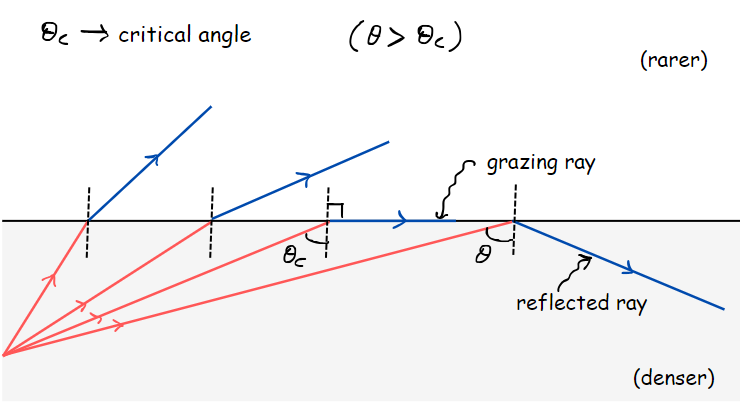
Now, this specific case of Total Internal Reflection (TIR) happens when the light travels from a denser medium to a rarer medium.
From the figure, as we keep increasing the angle of incidence, the angle of refraction also increases until the critical angle is reached.
Critical Angle :
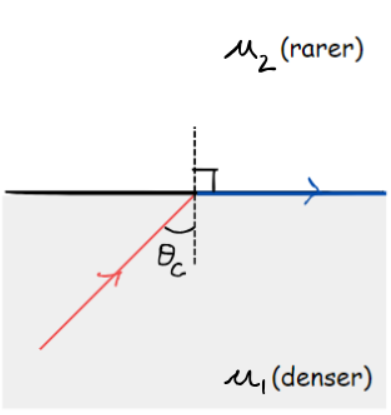
For each medium interface, we have a special angle defined, known as the critical angle. In simple words, it is the angle of incidence at which the refracted ray grazes along the medium-separating interface (the angle of refraction becomes 90 deg).
By Snell’s law,
TIR Condition :
When the angle of incidence goes beyond this critical angle, the ray gets ‘reflected back’ into the ‘same medium’. This phenomenon is called ‘Total Internal Reflection.’
3. Difference between Normal and Total Internal Reflection:
3.1 Normal Reflection:
- The intensity of the incident ray is much greater than the intensity of the reflected ray. This is because during normal reflection, a part of the light gets absorbed by the material through which it hits, and some of it gets transmitted further.

3.2 Total Internal Reflection:
- In this case, the incident ray intensity is retained 100% by the reflected ray. This is the major difference between Normal Reflection and Total Internal Reflection

A Question from JEE Advanced Previous Year Papers:
Question:
A light ray travelling in a glass medium is incident on the glass-air interface at an angle of incidence. The reflected (R) and transmitted (T) intensities, both as functions of theta, are plotted. The correct sketch is :

Answer : (C) option
- At an angle of incidence = 0°: Most of the light (not 100%) is transmitted.
- At an angle of incidence > critical angle: 100 % of light is reflected, and hence 0% transmission of light
FAQ section