Disclaimer: This problem is mainly designed to act as a bridge between the chess and physics communities. What I mean by this is that Physics people need to learn basic chess, while Chess players need to learn a little physics to solve this problem.
Problem Statement
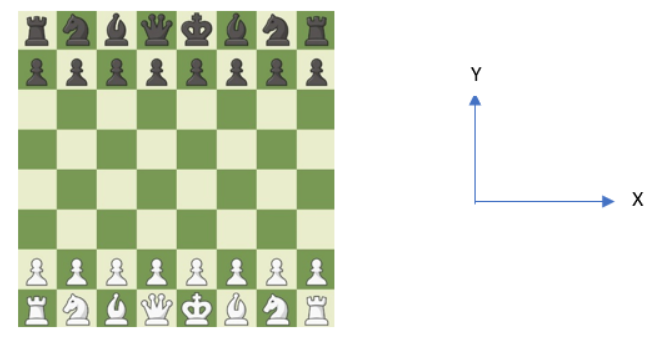
Two friends decide to play a friendly match. Both of them sit for the match. The following game (given below) has been played on the chessboard by them. The square-shaped chessboard has a length of ‘8L’.
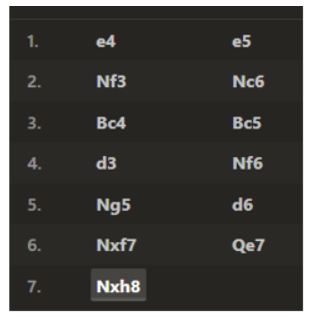
Getting frustrated with the piece loss, the player with the Black pieces decides to resign the game, and the result of the game is 1-0
Question Parts:
- Part (a): With reference to the game played, find out the displacement vector of the white’s g1 knight after the 7th move from the white side has been completed. (Take the origin as the center of the chessboard)
- Part (b): Does the position of origin matter in the answer to part 1?
Assumptions:
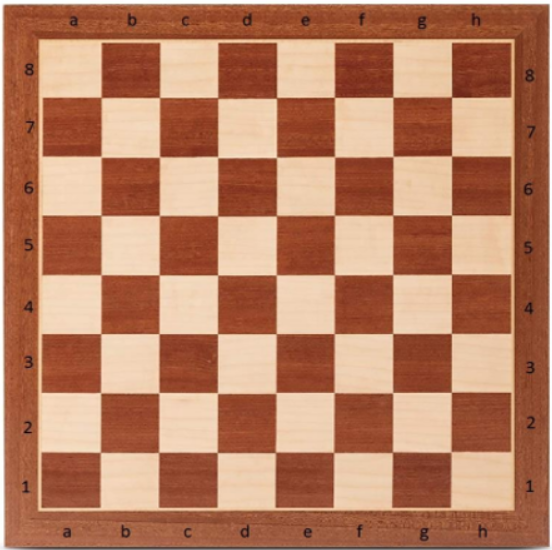
Assume the pieces to be point masses and are located at the center of respective squares (Chess Notations can be observed from the figure below)
Solution:
The physics problem is purely based on the concepts of ‘Vectors’.
Vectors can be broken into components to simplify the problem. This is exactly what we will be using for this problem. To learn more about the application of vectors, you can refer to the article on Projectile Motion.
To play around with vectors, you can use the simulator by clicking here.
Concept:
Displacement vector: The vector that represents the change in position vector for a body pointing from initial position to final vector is basically known as the displacement vector.
The diagram below will help you visualize the displacement vector better:
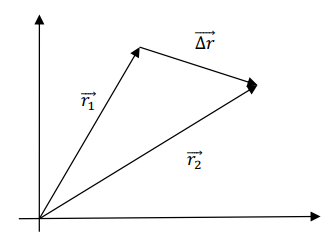
Here,
\(\vec{\Delta r}\) (or say \(\vec{r}_3\)) = \(\vec{r}_2 – \vec{r}_1\)
Where,
\(\vec{r}_1\) is the position vector for initial position of body
\(\vec{r}_2\) is the position vector for final position of body
\(\vec{r}_3\) is called displacement vector since it represents displacement
Returning to our problem solution,
Part (a):
There are two ways through which we can approach the problem, and both are necessary for our better understanding:
- Quick method
- Polygon law of vector addition
Quick Method:
Since the quantity here we are asked to deal with is ‘displacement’ and displacement being a vector quantity, we need to be concerned about the initial and the final position of the body. Consider the geometric center of the board as the origin, and define the X and Y axes (i.e., the 2-D coordinate system) as shown.
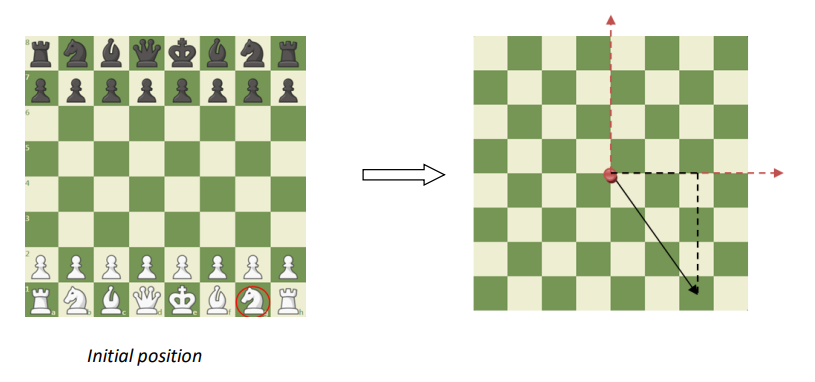
So the initial vector can be written as (say \(\vec{r}_1\)), then
\(\displaystyle \vec{r}_1 = \left( \frac{5L}{2} \right) \hat{i} + \left( -\frac{7L}{2} \right) \hat{j}\)
\(\displaystyle \vec{r}_1 = \left( \frac{5L}{2} \right) \hat{i} – \left( \frac{7L}{2} \right) \hat{j} \qquad \text{—— (1)}\)
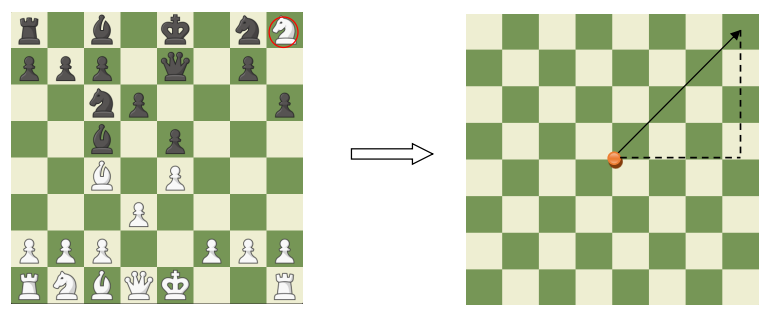
Here, for the final position, we can write the final position vector (\(\vec{r}_2\)) as :
\(\displaystyle \vec{r}_2 = \left( \frac{7L}{2} \right) \hat{i} + \left( \frac{7L}{2} \right) \hat{j} \qquad \text{—— (2)}\)
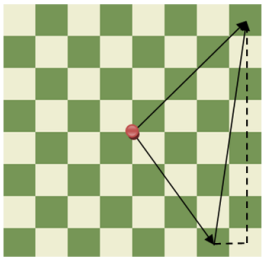
From triangle law of vector addition in adjacent figure,
\(\displaystyle \vec{r}_2 = \vec{r}_1 + \vec{r}_3\)
\(\displaystyle \therefore \vec{r}_3 = \vec{r}_2 – \vec{r}_1\)
\(\displaystyle \vec{r}_3 = \left[ \left( \frac{7L}{2} \right) \hat{i} + \left( \frac{7L}{2} \right) \hat{j} \right] – \left[ \left( \frac{5L}{2} \right) \hat{i} – \left( \frac{7L}{2} \right) \hat{j} \right]\)
\(\displaystyle \vec{r}_3 = L\hat{i} + 7L\hat{j}\)
The expression for r3 can also be verified from the figure shown above.
So, the total displacement vector for the g1 knight was \(\quad \vec{r}_3 = (L)\hat{i} + (7L)\hat{j}\)
Polygon Law of Vector Addition:
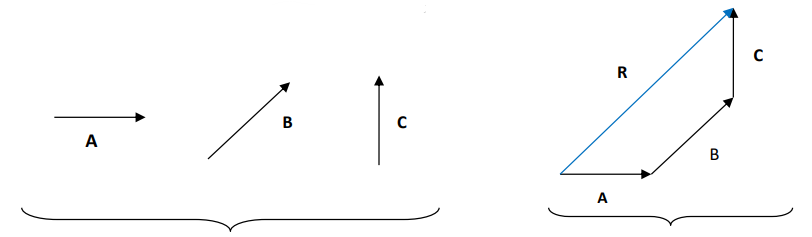
It helps in addition of two or more vectors. E.g. if we have three vectors (A, B, C)and we aim to find the resultant of the these vectors (𝑅), then we need to first arrange the vectors in order (i.e. join the tail of B to head of A & tail of C to head to B) and then we get the resultant by joining the tail of the first vector (here A) to the head of the last vector (here C)
R = A + B + C
In the game, white’s g1 knight moved multiple times to various squares (from g1 to f3, then from f3 to g5, then from g5 to f7, and then finally from f7 to h8). These moves can be represented as displacement vectors, and the resultant of which will give the total displacement of the g1 knight from the initial position to the final position, which will be our answer.
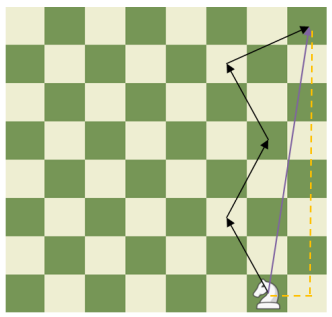
| Moves of knight | Corresponding vectors |
|---|---|
| g1 to f3 | (-L)i + (2L)j |
| f3 to g5 | (L)i + (2L)j |
| g5 to f7 | (-L)i + (2L)j |
| f7 to h8 | (2L)i + (L)j |
Now for the total displacement vector, we need to just add all the corresponding vectors, which results in:
\(\displaystyle \begin{aligned} \text{Total displacement vector} &= [(-L)\hat{i} + (2L)\hat{j}] + [(L)\hat{i} + (2L)\hat{j}] + [(-L)\hat{i} + (2L)\hat{j}] + [(2L)\hat{i} + (L)\hat{j}] \\ &= (L)\hat{i} + (7L)\hat{j} \end{aligned}\)
This can be verified from the above figure as well.
So, the total displacement vector for the g1 knight was \(\quad \vec{r}_3 = (L)\hat{i} + (7L)\hat{j}\)
Part (b):
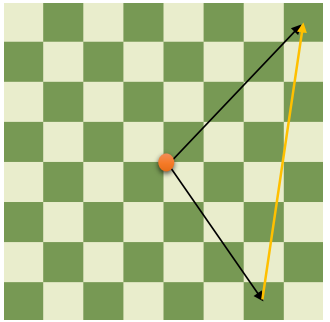
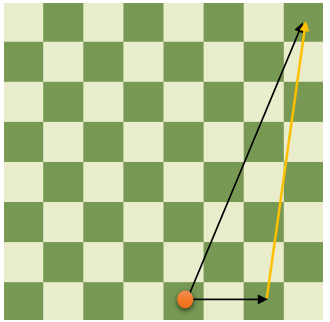
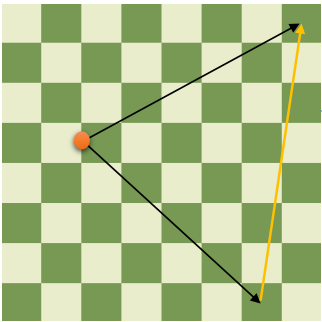
- In the whole problem, we considered the geometric center of the board to be the origin, but you can use any point in the 2-D plane as your origin, and even with that, you are bound to get the same answer for the total displacement vector. The reason behind this is that the displacement vector literally just doesn’t care about the origin. The main thing for it is the initial position of the body and the final position to which body goes.
Compare the following cases and just verify by yourself that the displacement vector is independent of the origin considered. (observe the yellow vector (displacement vector))
‘’Position vectors change with origin, but displacement vectors do not.’’
In the figures below, the origin is placed at random places, but you will find that the displacement vector doesn’t change in any of these cases.
Some additional information on the ‘chess’ side:
- The opening played in the game is the ‘Italian opening’. It proceeds as (1. e4 e5 2. Nf3 Nc6 3.Bc4)
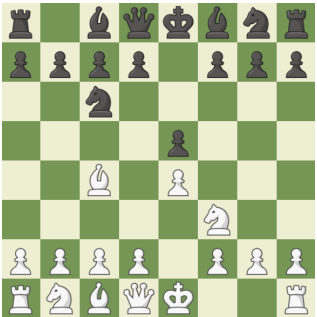
- The move Nxf7 (check question) was ‘game-deciding’ because it forks (i.e. attacks two major pieces at the same time) Queen and the rook, which means trying to save any one of them would result in capture of the other. This is one of the most common traps in Italian that most of the beginners fall. So beware!