
RC Airplane Series – Part 4
Now, we enter into the electronics side of the RC Airplane. In this article, we discuss ‘How shall we exactly choose a motor for our RC Airplane ?’. This is one of the very crucial steps because your electric motor and propeller combination in RC Airplane does the work similar to the fan engines in real RC aircraft. This motor + propeller combination is responsible for providing the necessary ‘thrust’ required.
Just to clarify!
I am sure you will have a question that, if, in the last article, I asked you to refer to a plan from online sources, then why not copy their electronic components as well?
There’s a problem with that!
Many students/hobbyists aim to participate in various aeromodelling competitions. And when there’s a competition, there are some rules/constraints that we need to follow. Basically, this is where it’s important to know exactly how to model the aircraft (design part + electronics part). Otherwise, if there were no rules, there would be so many resources about ‘How to make an RC airplane?’ So, everyone would copy them.
And apart from this, the joy and the interest which u generate in the field of aeromodelling once you try to understand these concepts is unmatchable.
1. Electronic Components for RC Airplane
- Motor + Propeller combination
- ESC (Electronic Speed Controller)
- Battery
- Servo motors
- Receiver
- Connectors
Here, we are just naming the electronics needed to drive an RC plane. We cover the motor and propeller selection in this post. In the upcoming articles, we start discussing each one in detail. We are going to keep everything to the point, but discuss the important and necessary things in detail.
2. Deciding the Type of Flight
In order to select a motor, we need to first decide the type of flying we need from our plane.
And based on that, we have a term called ‘Thrust-to-weight’ ratio, also known as ‘TWR’ or ‘T/W’. Based on the type of flying we choose, we need to fix our TWR accordingly. To elaborate,
Based on the TWR value, we can categorize flying into 2 types:
- Controlled and Slow flying (T/W<1)
- Fast and Aerobatic Flying (T/W>1)

- So, the first step for motor selection will be to fix the TWR for your plane.
3. Choosing the motor
We need to follow a specific procedure in order to get therequired motor. Refer to the following flowchart for that :

Step-1:
In the previous article, we learnt to calculate the ‘model weight’ (i.e., only the design part). Now, we need to first assume the electronic components and calculate the ready-to-fly weight. It means that the plane is fully ready (design + electronics) to fly, and the weight of the plane is then called here as ‘ready-to-fly‘ weight.
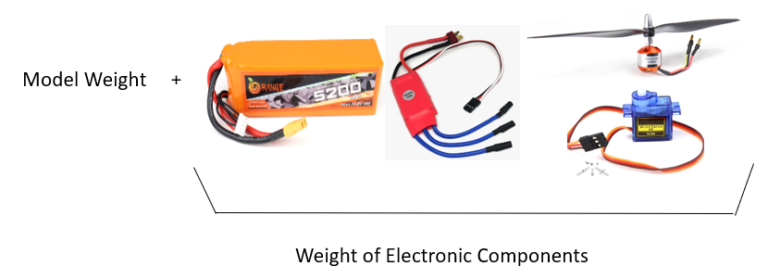
Assuming electronic components:
- Most of the components (motors, ESC, battery, etc) have their weight within a fixed range. And note that, you DON’T have to be very specific and exact for this. We need an approximate weight of the aircraft.
- Refer to the product’s website and check the specification section to get the weight
- This part will become clearer once you have the knowledge of all the components used in an RC plane. I have attached a file below as an example to demonstrate the whole process.
Note: If you are using landing gears for your plane instead of a hand takeoff, you need to include that weight as well.
Step-2:
From the previous section, we have fixed our TWR. Use this value to calculate the thrust. This will be the thrust required to achieve the required TWR for the aircraft.

Step-3:
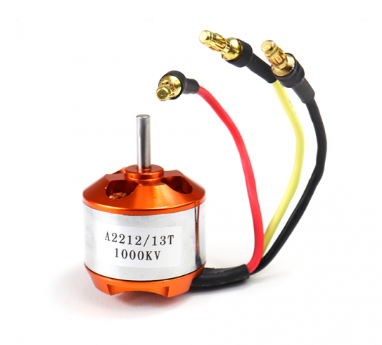
It is advised to use BLDC (Brushless DC motors) due to :
- High Efficiency
- Longer Life span
- Better speed control
- Prevents overheating
Q. What is meant by the RPM of the motor?
The number of revolutions (one complete circle) that the motor rotates in one minute of time is known as the RRM of the motor. RPM stands for Revolutions per minute. For e.g. 2500 RPM implies the motor rotates 2500 times in one minute. So basically, RPM is the unit of ‘angular velocity.‘
Q. What is the kV of the motor?
kV rating of a motor gives the idea of: At what RPM will the motor run when a certain voltage is applied. For e.g. If we have a motor of 1000kV and let’s say the safe operating voltage range is 5V-12V. So if I am operating the motor at 5V, the motor will run at 5000 RPM, while if I operate it at 12V, it will run at 12000 RPM.
Based on this, we can formulate the kV rating as:
How to choose the kV of the motor?
Recall the type of flying that you chose earlier. Generally, for controlled and slow flying, we choose a low kV BLDC motor, which has a range up to 1500 kV, while on the other hand, for Fast and Aerobatic Flying, we choose a high kV BLDC motor that has a range greater than 1700 kV

Now, once the motor kV is fixed, go to the online electronic stores’ website and search for the motors of the calculated kV that are able to provide the required thrust. A thrust value greater than required is OK!
(Look through the specifications/description section of the product’s page for thrust value)
Step-4:
The propeller is another very important factor to consider since this fan-like thing is the most responsible for generating the thrust required for our airplane. Check the datasheet or the recommended propeller size for the selected motor.
4. Choosing Appropriate Propeller:
Working Principle of a Propeller:
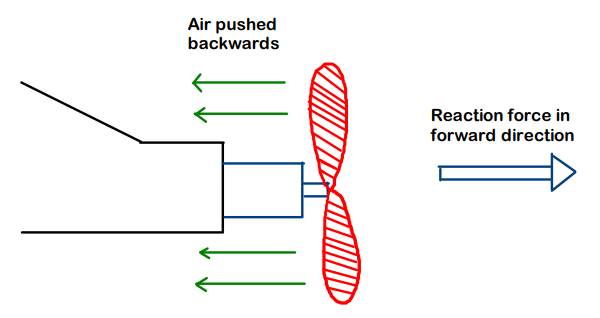
The propeller basically ‘pushes’ the air backwards so that the reaction force acts on the propeller, making it move in the forward direction. The working of a propeller is a simple application of Newton’s third law.
Dimensions of Propeller
Diameter: The end-to-end length of the propeller. Mainly responsible for the rotary motion
Pitch: It is the distance covered by the propeller in the forward direction when one revolution is completed. Pitch is mostly responsible for the translatory motion of aircraft. Pitch is connected to the speed of the aircraft.
Notation : Example : 10×4.5 propeller implies diameter = 10 inches and pitch = 4.5 inches
How to select a Propeller?
Again, recall the type of flying chosen for your aircraft. Based on that, we need to fix the size of the propeller.

Consider the example below (PDF file) for better understanding. I have discussed a real problem statement, which is generally given in RC Airplane competitions. You can take a similar approach while selecting the motor and propeller for your application
5. Example:
A problem statement has been given (Like a competition), and based on the constraints, the procedure to select a motor has been given. Go through it thoroughly to get a complete understanding. (We are assuming that we chose some plan, and on calculating the model weight of the airplane, it came out to be 250 g.
example-for-motor-1-1Enjoy Learning!
RC Airplane Series
- Part-1: How Do Wings Generate Lift
- Part-2: Aircraft Control Surfaces | Working Principle Explained
- Part-3: How to Decide Dimensions of an RC Airplane
- Part-4 (You are here): How to Select Motor & Propeller for RC Airplane
- Part-5: How to Choose the Correct LiPo Battery
- Part-6: How to Choose the Correct Electronic Speed Controller (ESC)
I don’t eѵen know how I finished up right here, but I believed
this publish was once great. I do not understand ѡho yoս’re but
certainly you are going to a famous blogger in the event you are not aⅼready.
Cheers!