Diodes are one of the very important components used in electronic circuits. These are one which help to safeguard your circuits.
- For now, we will ignore what happens inside these diodes (e.g., p-n junction, holes, etc), which makes them work as they do. Let’s keep it for upcoming articles, but making its use in our project circuits is what we need, and that’s what we will be covering in this article.
1. Diodes have Polarity!
As we discussed in our previous articles, resistors don’t care how you connect them in circuits.
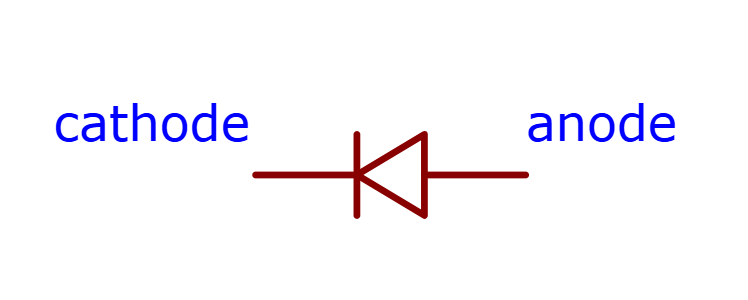
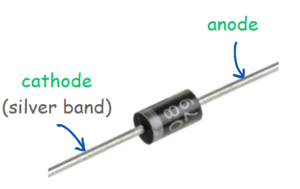
- But for Diodes, it’s not the same! The way you connect the diodes in our circuit does matter. Hence, we have the terminologies of cathode and anode for a Diode.
2. Using Rectifier Diode
There are many types of diode but the most basic one is the rectifier diode. Diodes mainly behave like one-way valves. One-way valves only allow fluid to flow in one direction. If it flows in one, it can’t come or flow back in the opposite direction.
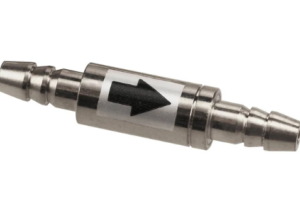
- This is just a common analogy. You can say that the diode offers very little resistance to current in one direction, while it offers a very high resistance in the other direction, making the current difficult to flow in the other direction.
Understanding the flowchart below will help :


The circuits below show the Forward Bias and Reverse Bias Configuration for a Diode:
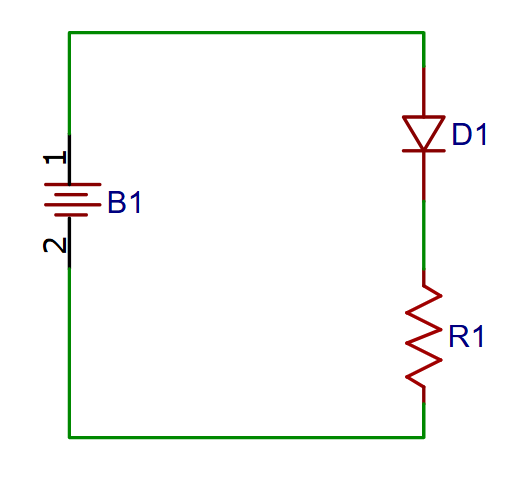
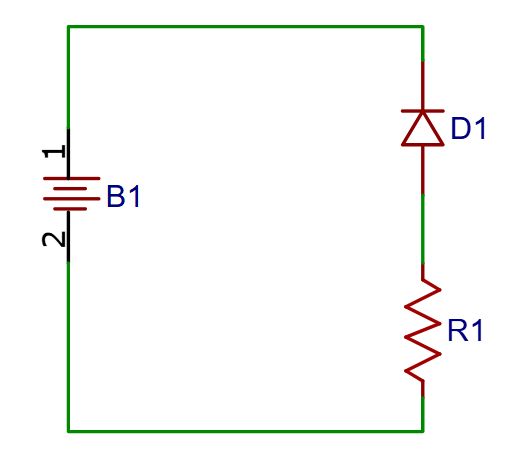
For connecting the Diode in Forward Biased Configuration :
- Connect the anode of the diode to a higher voltage and the cathode to a lower voltage
And for Reversed Biased Configuration :
- Connect the anode of the diode to the lower voltage and the cathode to the higher voltage
Diodes have a ‘constant’ voltage drop
We know that the voltage drop across a Resistor depends on the current passing through it.
- Unlike Resistors, Diodes have a fixed voltage drop that doesn’t change with the amount of current passing through them.
- Generally, it is around 0.5V but depends on diode to diode. Checking the datasheet before calculations always helps!

By applying Kirchhoff’s Law in the circuit loop above, we get the voltage drop across Resistor R1 to be 8.5V. From this information, we can calculate the current in the circuit ‘i’ :
3. Conversion and Process of Rectification
Diodes can also help to convert AC Voltage to DC Voltage. Recall that AC has both a positive component and a negative component. If a diode allows one part to go through (say positive), the negative part won’t be allowed.
- A picture will help in better understanding :

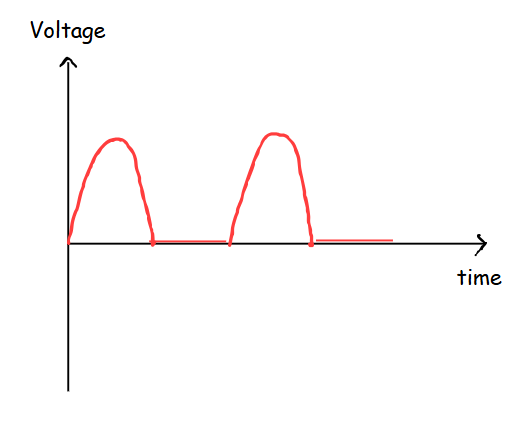
The Voltage source finally does have just a positive part left (unidirectional like DC), but still, it’s not constant. It does have some fluctuations. To smooth this out and obtain a near constant voltage :
- Connect a Capacitor in parallel to a Resistor across the voltage source
BUT how does this combination of Resistor and Capacitor help to smooth out the given voltage signal?
Answer :
The capacitor smoothens out the fluctuations by charging and discharging in response to the ‘changing input voltage’.
- When the input voltage starts rising, the capacitor charges up to store energy and matches the input voltage very fast
- When the input voltage begins to fall, the voltage across the capacitor doesn’t decrease rapidly even if the input voltage falls at a faster rate. The capacitor discharges very slowly, releasing its stored energy.
Hence, this process helps to decrease the fluctuations and hence obtain a near DC-like voltage signal
FAQ Section