
Till now, we have learnt about the Resistor, basically how it works, what its applications are, how to use it in a circuit, etc. But we come across the circuits that involve some combinations of resistors. Our aim in this article is to simplify this network and obtain the equivalent resistance of the network.
1. What is meant by finding equivalent resistance ?
When it comes to circuit solving, we will encounter lot of complex combination of resistors present in the circuit. Finding ‘equivalent’ of such combination of resistors means that, we must be able to replace that whole thing with just a single resistor without changing any of the other parameters (current, potential difference across given points, etc. ) in the circuit.
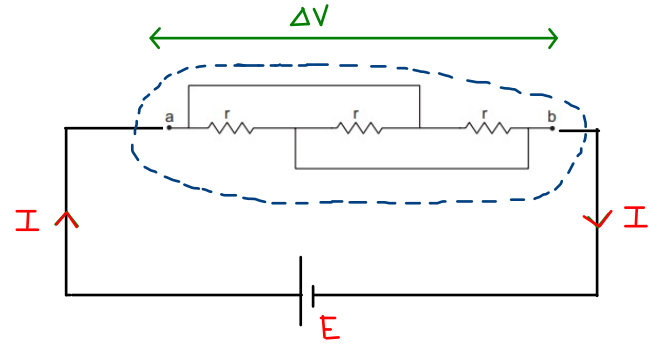
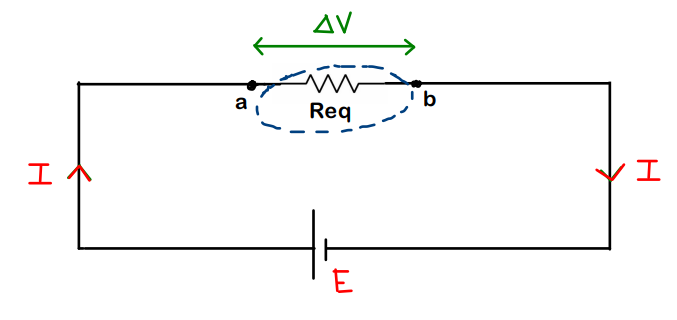
Note that, in Fig.1 (a) and (b), except for the number of resistors, there is no change in other parameters (I remains I, E remains E, V remains V)
Now, how to actually calculate this value of Req is what we need to study in this article
2. Resistors in Series
Resistors are said to be in Series when the current flowing through them is the same. Done!
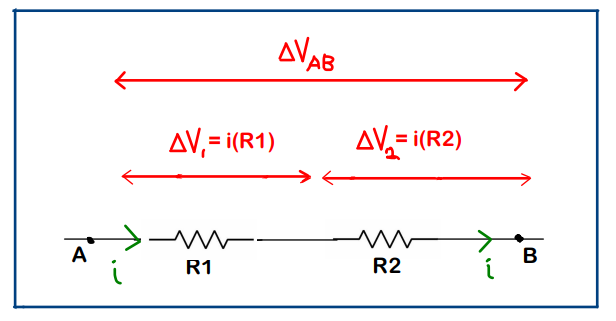
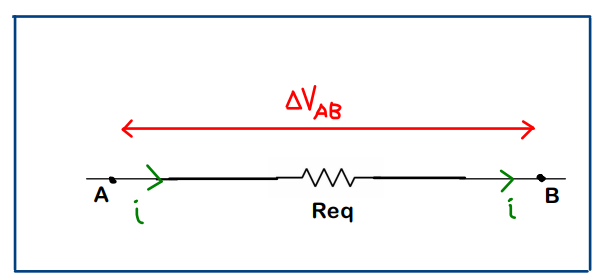
Now, with reference to the above figure,
The voltage drop across Req should be equal to the sum of the voltage drops across R1 and R2, since our main aim is not to disturb the potential difference between points A and B ()
Important Note:
From the above relation, we can infer that we can use series combination if we need a resistance value greater than the individual resistances (i.e., Req > R1 & also Req > R2)
So, Resistors in Series just add up directly!
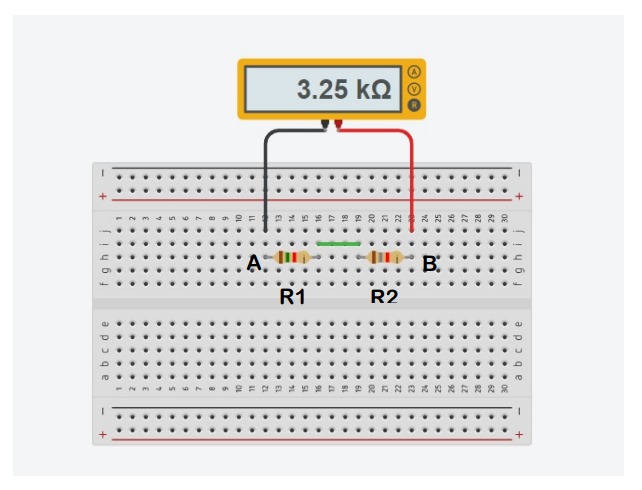
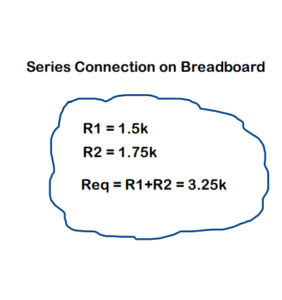
The figure below shows the series combination of R1 and R2 resistors having resistances of 1.5 kΩ and 1.75 kΩ. The equivalent resistance Req in this case is measured by a multimeter in Tinkercad. The value for Req comes out to be 3.25 kΩ
3. Resistors in Parallel
Resistors are said to be in parallel, when they have same potential difference across them. Done!

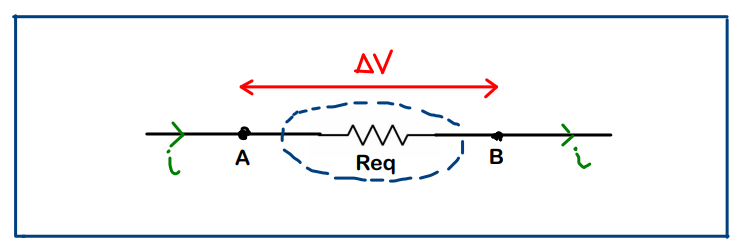
The potential difference across Req should also be equal to the potential differences across R1 and R2 (i.e., V), since our main aim is not to disturb the potential difference between points A and B
Here, the quantity that is varying is current, and by applying KCL starting from A, we have the relation,
Important Note :
From the above relation, we can infer that we can use parallel combination if we need a resistance value even lower than the individual resistances. (i.e. Req < R1 & also Req < R2)
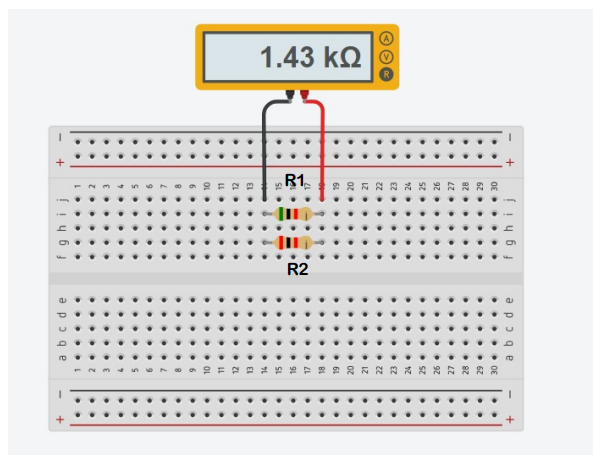
Breadboard Connections for parallel combination (in Tinkercad):

4. Example on Series & Parallel Combinations
Question-1
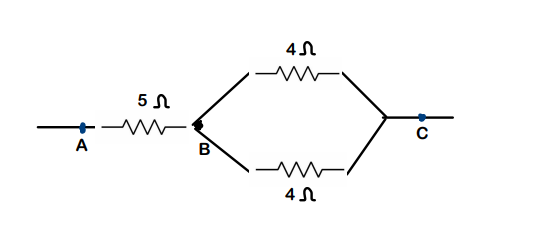
Find the equivalent resistance of the given setup across points A and C
Solution:
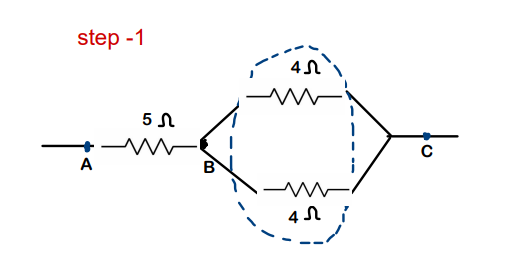
Step – 1: Both the 4 Ω resistors are connected across the same points B and C. Hence, both are in parallel combination. Req for just this combination will be 2 Ω
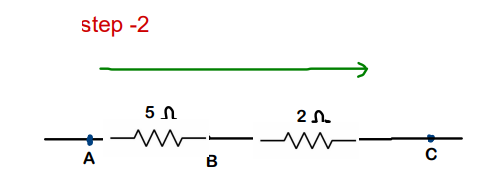
Step-2: Now, 5Ω and 2 Ω are in series combination. Req of this will be 7Ω
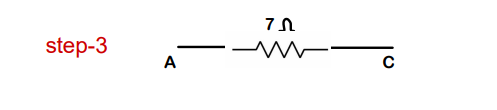
Step-3 : Finally, we have 7 Ω resistor between A and C. This is our final Req between points A and C
Question – 2: Find the effective resistance between points A and B for the figure below
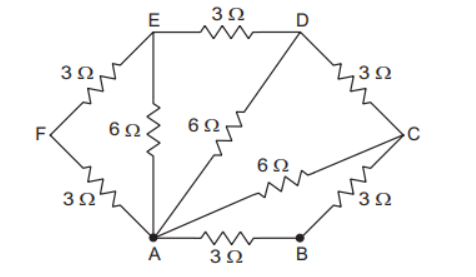
Solution:
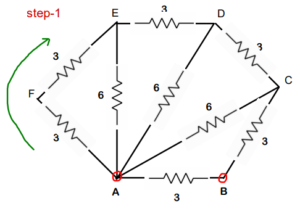
Step 1 : Same current passes through AF and FE, which makes both the 3 ohm resistors in series. Req for this will be 3Ω+3Ω = 6 Ω
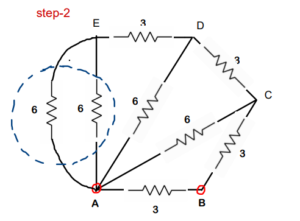
Step 2 : Two 6 Ω resistors are connected across same points A and E which makes them in parallel. Req for this will be 3ohm
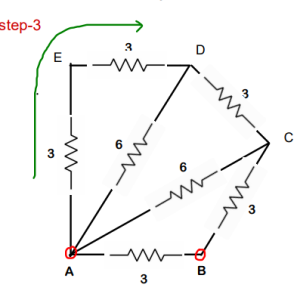
Step 3 : Again, both 3 Ω are in series. Req will be 6 Ω
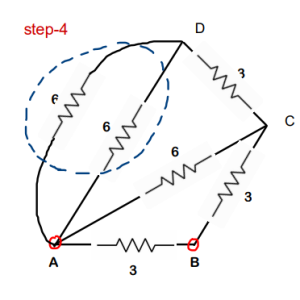
Step 4: Both 6 Ω are in parallel. Req will be 3 Ω
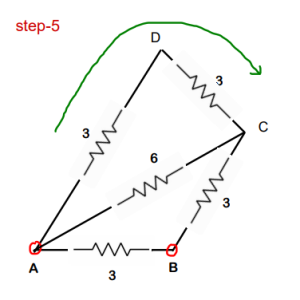
Step-5 : 3 Ω and 3 Ω are in series. Req of this will be 6 Ω
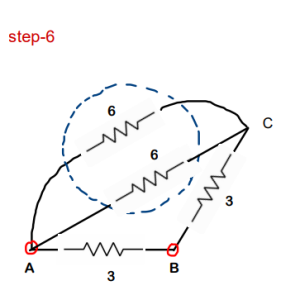
Step-6: two 6 Ω resistors are in parallel. Req of this will be 3 Ω. Keep on simplifying further.
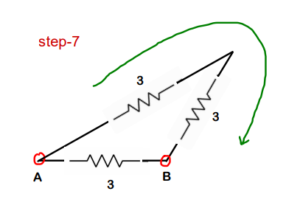
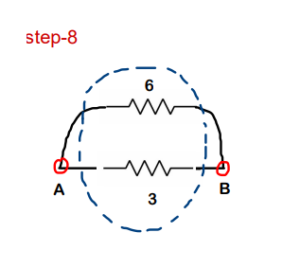
Step-7 : 3 Ω and 3Ω are in series
Step-8: 6 Ω and 3Ω are in parallel. Solving this combination, we get Req of this as 2ohms.
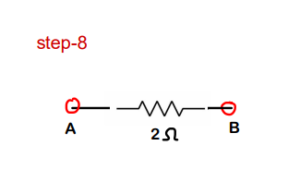
Final Answer : So, the overall equivalent resistance across points A and B is 2 Ω
The Complete Guide on Resistors:
- Part-1: What Is a Resistor & How to Use It in Circuits
- Part-2: Types of Resistors, Color Coding & Power Rating
- Part-3 (You are here): Combining Resistors: Series, Parallel & Equivalent Resistance
- Part-4: How to Solve Resistor Networks – Methods & Examples