In Part one, we learned what capacitors are, how they work, and whythey are used in circuits. We have learnt about the working of a capacitor and also discussed its response to alternating current and direct current. Before moving further, we need to know about Capacitance. Because this is the value that tells us how much a capacitor can store in itself. Have a look at the definition.
Understanding Capacitance
Capacitance is the ability of the body to store charge.
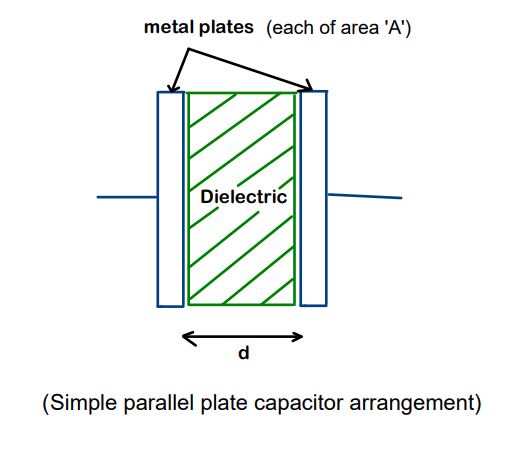
But this ability itself depends on 3 things:
- Surface area of the metal plates
- Type of dielectric which we are using between the plates
- Distance between the plates
- Unit of capacitance : farad (F)
- 1F implies that the capacitor has the ability to store 1C of charge on each plate (+1C and -1C) when 1V of potential difference is applied across it.
For example, we have 2 capacitors. 1st has a capacitance of 2F and 2nd has a capacitance of 10F. Which has more capacitance ?
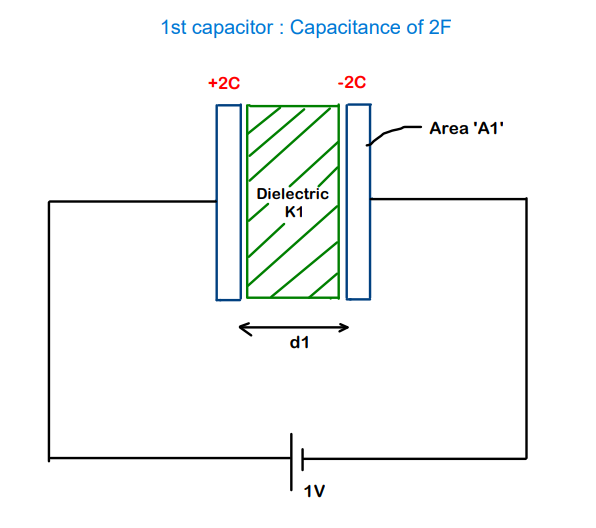
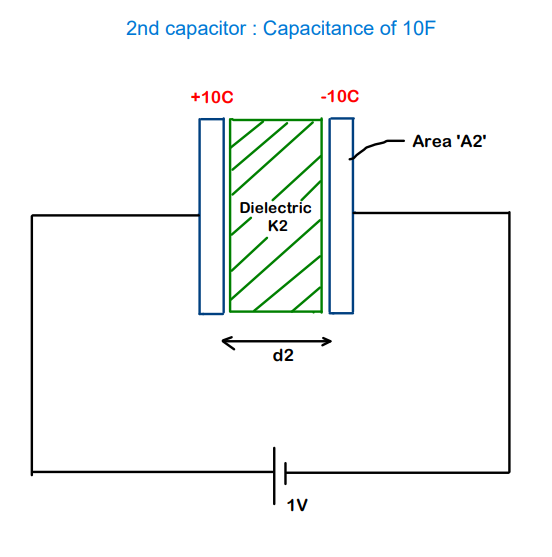
For the 2F capacitor, we can store 2C charge on plates with the potential difference of 1V. But for the same potential difference of 1V, we can store 10C of charge in case of 10F capacitor. So obviously, 10F is a capacitor of higher capacitance than 2F
Note:
- We can observe that the area of the plates, the distance between the plate and the dielectric are different for both. It is not possible to have different capacitances with the same 3 parameters. At least one of them should differ!
For example,
- You need to store 5 laddus in a given container. On keeping all the laddus, You find the container is fully filled.
- Next, you are asked to fill 10 laddus in a container of your choice. You won’t choose the previous container; instead, you would choose the one with larger dimensions -> since it gives more capacity!

Reading Values of Capacitor:
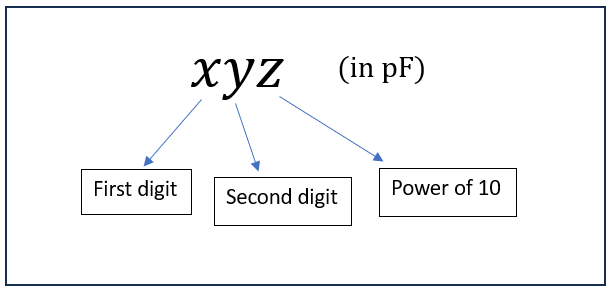
We have a three-digit marking system for mica disc capacitors. Note that, this gives the capacitance value in pF (picofarads). Refer to the picture below.
- The first number represents the first digit of the capacitance value
- The second number represents the second digit of the capacitance value
- The third number represents the power of ten
For example,
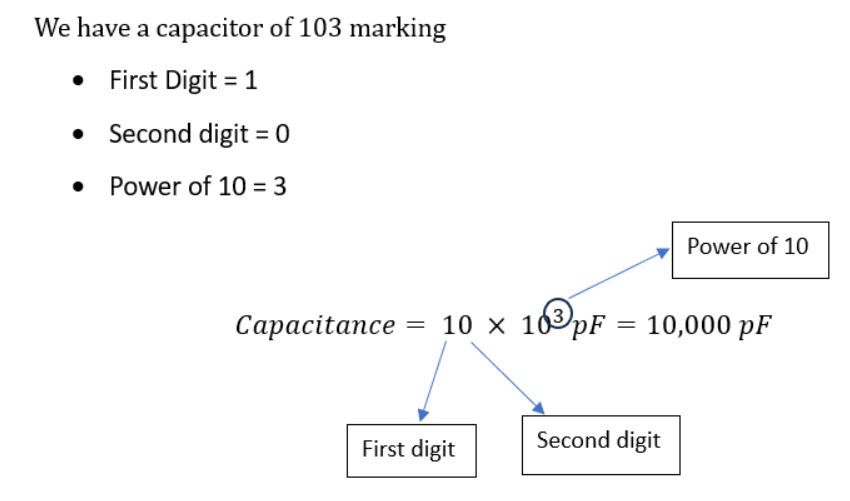
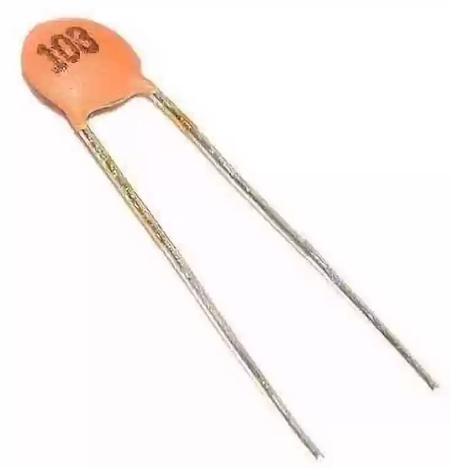
We have a capacitor of 103 marking on it
- First digit for capacitance = 1
- Second digit for capacitance = 2
- Power of ten = 3
Hence the value of the capacitance will be 10e3 pF or 10,000 pF
Checking Working Voltage or Rated Voltage of a Capacitor:
Often, you will also see one more value in addition to the capacitance. It is usually given in V (volts). This is nothing but the ‘Working voltage’ and also known as ‘Rated Voltage’.
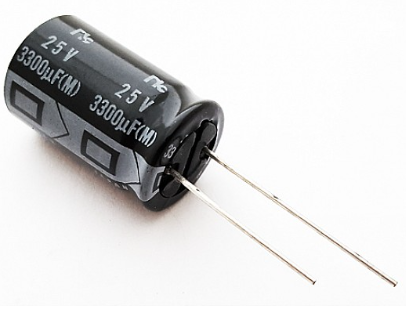
Your capacitor should atleast have a working voltage which is 10-15 % higher than the supply voltage in your circuit. This keeps your circuit safe and also keeps you safe !!
Precaution: Take Care of Polarity!
Some Capacitors are polarized which means that, the way you insert them/connect them to the circuit matters a lot !
- The positively marked terminal should be kept at a higher voltage than the negative terminal
Usually, the manufacturers keep a separate band which directs the user towards the negative terminal of polarized capacitor.
Conclusion:
In this article, we got know the basics about the capacitors. But, the fact that it is basic, doesn’t make it less important.
Similar to the Resistors, Capacitors can also be combined together in order to get a single capacitance out of the given network/circuit. In addition to this, there are also some important things to be covered about Dielectrics in capacitor.
Keep Learning ! All the Best