Introduction
Low Pass Filters and High Pass Filters are two of the most important circuits to understand because of their extensive applications in electronics. In this article, we will explore their working principles, examine how they are constructed, and understand the reasoning behind their names.
1. What is Capacitive Reactance?
There’s a very common difference between a resistor and a capacitor :
- In the case of a resistor, the resistance value remains constant, i.e., it doesn’t change even when varying the current or the voltage.
- But unlike a resistor, the value of capacitance depends on the current and voltage in the circuit.
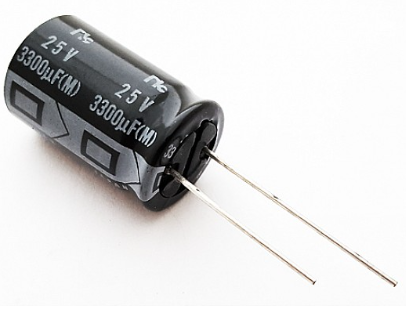
We have already learnt about Charging and Discharging of Capacitors in the article: What is a Capacitor | Charging & Discharging – Part 1. According to that, if our circuit consists of only a Capacitor attached to a battery, then :
- Capacitor blocks the DC current except at the time of charging & discharging
- Capacitor allows AC easily, as it is nothing but a cycle of charging, discharging, and recharging
Refer to the timeline diagram below, which shows how resistance to electron flow is offered by the capacitor during charging.

Text Version of the above flowchart (Expand This)
1.Battery attached to uncharged capacitor.
2. Easy flow of electrons initially due to high potential difference (p.d.) ➜ less resistance.
3. Capacitor keeps on charging ➜ this makes the potential difference between the capacitor and battery to reduce.
4. As the capacitor is about to get fully charged, the current reduces ➜ strong opposition to electron flow.
This resistance offered by a Capacitor is referred to as ‘Capacitive Reactance.’
We denote it as ‘Xc‘
Capacitive Reactance is formulated as:
where f represents the frequency of the source
Note: Here, I have shown a special case below
Case: DC Source is attached across the capacitor
Result: We all know that the frequency of the DC Source is zero, as there is no switching in polarity. Therefore, f=0 and we get reactance as infinite. Hence, we can see that the circuit almost behaves as an open circuit in the case of a DC Source.
Substituting f=0 in Xc formula:
And also in case of AC Source, it is quite evident from the formula that, if the frequency of the source is increased, it results in a decrease of capacitive reactance. Let’s take 2 cases to understand this: Both are AC Source – One with f = 50kHz and the second with f = 10Hz (Capacitance is 10uF)
Sub-Case f = 50 kHz
Sub-Case f = 10 Hz
Hence, verified!
2. Using Ohm’s Law
- It is possible to use Ohm’s Law in this case as well. Just consider the capacitive reactance as some kind of resistor and then apply Ohm’s Law to it.
- But note that: Just one frequency at a time while using Ohm’s Law
Let’s calculate the peak current achieved in the circuits in the 2 examples considered in the previous section-1. The circuit has all the parameters the same, just the peak voltage of the AC Source is now given to be 5V.

Sub-Case 1
Sub-Case 2
3. Selecting Specific Frequencies
This frequency-dependent behaviour of capacitors makes them suitable for building some special types of circuits called Low Pass Filter and High Pass Filter Circuits.
- Capacitors block DC and allow AC. But with the help of these filter circuits, we can control which AC signals will specifically be allowed to pass. Hence, we call them filtering circuits
Just remember this analogy :

- Getting a voltage somewhere is equivalent to getting a signal over there.
3.1 Low Pass Filter
To understand this circuit, let’s take 2 cases: one at low frequency (f=0) and another at very high frequency.

We can find the relation,
Case 1: Low Frequency (f = 0) of Source
This implies that the source behaves like a DC. And we know that, in steady state, Vc = Vout = Vin, i.e., the whole source voltage comes across the capacitor.
Case 2: Very High Frequency of Source
At high frequency, the capacitive reactance is low → This makes the capacitor behave as a short circuit → This implies that there is no voltage drop across the capacitor → Therefore, Vc = Vout = 0
As discussed earlier,
If we get a voltage at Vout, → It implies that we have the signal of that frequency over there. So, in the case of the above circuit, we are getting a voltage at Vout in the case of low frequency
- Hence, as the above circuit allows low-frequency signals to pass (from input to output), the circuit is known as a Low Pass filter
3.2 High Pass Filter
To understand this circuit, Again lets take the same 2 cases: one at low frequency (f=0) and another at very high frequency.

Case 1: Low Frequency (f = 0) of Source
This implies that the source behaves like a DC. And we know that, in steady state, Vc = Vin i.e. the whole source voltage comes across the capacitor. But Vout = 0 in this case, as Vout is now the voltage across the resistor (Therefore, Vout = VR = 0)
Case 2: Very High Frequency of Source
At high frequency, the capacitive reactance is low → This makes the capacitor behave as a short circuit → This implies that there is no voltage drop across the capacitor → Therefore, Vc = 0. But, because of this, the whole source voltage shifts to the resistor.
This makes VR= Vout = Vin
If we get a voltage at Vout, → It implies that we have the signal of that frequency at the output. So, in the case of the above circuit, we are getting a voltage at Vout in the case of high frequency
- Hence, as the above circuit allows high-frequency signals to pass (from input to output), the circuit is known as a High Pass Filter
Conclusion:
We have discussed the basics of the High and Low Pass Filter Circuits. The most fundamental difference between the two is the position of the output voltage.
- In the case of low pass filters, Vout is set across the capacitor
- While in the case of High Pass Filters, Vout is set across the resistor
Keep Learning!